 4K UHD
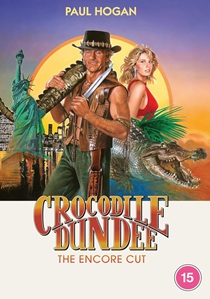
 An Australian bushman swaps the Outback for the streets of New York after a visiting American journalist introduces him to a very different kind of wilderness.

Details
When American journalist Sue Charlton (Linda Kozlowski) hears the remarkable story of an Australian bushman who survived an attack by a crocodile, she travels from New York to the tiny settlement of Walkabout Creek in Australia's Northern Territory to find out whether the legend lives up to the man.
Michael J. "Crocodile" Dundee (Paul Hogan) certainly isn't what she was expecting. A hunter, bushman and occasional crocodile poacher, Mick agrees to take Sue into the Australian wilderness and retrace the journey which nearly cost him his life.
Away from the comforts of civilisation, Sue quickly discovers that Mick's reputation isn't entirely based on tall stories. Whether dealing with crocodiles, snakes or the Australian landscape itself, there's seemingly very little that fazes him.
Having experienced Mick's world, Sue decides to turn the tables and invites him back to New York. For a man who has barely ventured beyond the Australian Outback, Manhattan proves an altogether different kind of wilderness.
Suddenly confronted by escalators, traffic, nightlife and some rather less friendly wildlife of the human variety, Mick applies his own straightforward approach to life in the big city. Yet as his relationship with Sue develops, her existing relationship with newspaper editor Richard Mason (Mark Blum) threatens to bring their unlikely adventure to an end.
Picture & Sound
For its first outing on 4K Ultra HD, Crocodile Dundee has undergone a substantial restoration rather than simply being given an upscale of an existing master.
The restoration was sourced from a 6K scan of the original camera negatives and interpositives held by Australia's National Film and Sound Archive, with the elements scanned by The Grainery in Canberra before the film was restored and mastered in 4K.
Given the age of the film, there's plenty of potential here for UHD to show what it can do without making a production from 1986 suddenly look as though it was shot yesterday.
For the most part, I found the level of grain just about right, although some scenes fare better than others. Film grain is always going to be something of a balancing act and, personally, I find excessive grain distracting, even though I know there will be collectors who would happily take considerably more of it.
The alternative, of course, can be considerably worse. There's absolutely no point scrubbing away every trace of grain with digital noise reduction if the end result leaves the actors looking as though they've been moulded from Plasticine. Thankfully, that certainly isn't the case here.
Indeed, the restoration reveals an impressive amount of fine detail. Close-ups of Mick leave virtually every nook and cranny of Paul Hogan's weathered face on display, yet it still looks entirely natural and appropriately film-like.
The Australian sequences provide some of the most obvious opportunities for the UHD presentation to impress. The landscapes, blue skies, animals, vegetation and various colour tones of the Outback give HDR plenty to work with without making the image appear unnaturally glossy. That said, I found some of the wider shots a little too grainy for my own taste.
I'm not entirely convinced the disc should take all of the blame here. Modern televisions perform an extraordinary amount of processing behind the scenes and I'll need to experiment with some of the processing being applied by my own 4K television. For now, though, I'd much rather have the occasional shot which looks a little grainier than I'd personally prefer than an overly processed image which has sacrificed genuine detail in an attempt to make a film approaching forty years old look unnaturally pristine.
Once Mick arrives in New York, things improve considerably. The brighter exterior scenes reveal an impressive amount of detail, with the city streets, buildings and crowds all benefiting from the additional resolution. There's a crispness to the image here which makes the most of the 4K presentation without looking artificially sharpened.
The darker interior scenes are handled with equal confidence. Shadow detail remains strong and there's no sense of the image becoming murky or losing definition when the lights go down, while the various lights of Manhattan provide a pleasing contrast to the more natural appearance of the Australian sequences.
Naturally, there's still some of that pesky grain to contend with - this is a film from 1986 after all - but I found it considerably less prominent than during some of the wider Outback shots. As a result, the New York section provides the more consistently impressive half of the presentation.
The soundtrack has also received a considerable upgrade for the restoration, with a new Dolby Atmos presentation giving Mick Dundee considerably more room to stretch his legs than he had back in 1986.
In practice, however, there's nothing particularly spectacular about the new mix. During the Australian sequences, the ever-present Australian-flavoured score, and particularly its distinctive guitar, is crisp and clear and occupies much of the soundstage. It's such an integral part of the film's character that hearing it reproduced with this level of clarity is arguably more important than having effects flying around the room.
Once Mick reaches New York, the music changes almost as dramatically as the scenery. The laid-back Australian themes give way to a much more up-tempo score which perfectly complements the hectic streets and pace of the city. The brass instruments in particular have real presence, piercing through the soundstage with impressive clarity and giving these sequences considerably more energy.
It's another clever part of the film's transition from the Outback to Manhattan. Just as Mick suddenly finds himself surrounded by traffic, crowds and unfamiliar sights, the soundtrack becomes noticeably busier too.
Dialogue remains crisp and perfectly intelligible throughout, while there's good separation across the front channels. The surround channels aren't especially aggressive, but they are used for ambient effects and become noticeably more active once Mick reaches New York. The additional bustle of the city helps open up the soundstage, placing some of the background activity around the listening position rather than keeping everything firmly anchored to the front.
Menu & Extras
The main extra is the Love of an Icon: The Legend of Crocodile Dundee documentary, and it's definitely worth making time for this one. Co-directed by John Cornell's widow Delvene Delaney and Victoria Baldock, it brings together new interviews with Paul Hogan and Linda Kozlowski, along with director Peter Faiman, cinematographer Russell Boyd and composer Peter Best, while John Cornell, David Gulpilil and John Meillon are amongst those remembered through archive footage.
Rather than simply being another collection of talking heads telling us how wonderful the film is, it's a genuinely affectionate and surprisingly emotional look back at Crocodile Dundee, the people who made it and the extraordinary phenomenon it became. Delaney's involvement gives proceedings an especially personal quality, with the documentary becoming as much a celebration of the friendships and people behind the film as the film itself.
And extraordinary really is the word. I knew Crocodile Dundee had been a big hit, but I hadn't quite appreciated just how big. Made for a relatively modest budget, it went on to become an enormous international success, taking hundreds of millions of dollars worldwide and becoming one of the biggest films of 1986. The level of interest surrounding both the film and Paul Hogan was quite remarkable and, watching the documentary now, it's difficult to imagine just how suddenly the whole thing exploded.
Perhaps inevitably, there's also a slightly melancholy side to proceedings. Nearly forty years have passed and everybody is considerably older, while some of those responsible for the film are sadly no longer with us. Paul Hogan himself is now well into his eighties and has experienced health problems in recent years, making footage of him looking back at the character which changed his life feel rather more poignant than it might otherwise have done.
That's perhaps what surprised me most about the documentary. You go into it expecting some entertaining anecdotes about making Crocodile Dundee and instead find yourself being reminded just how much of your own time has passed too.
There's plenty of fascinating material along the way too, particularly concerning the unlikely journey from an Australian production to a worldwide box-office phenomenon. The sheer amount of money the film eventually made is astonishing, but equally remarkable is the cultural impact it enjoyed. For a period, Crocodile Dundee wasn't simply a successful film - it was absolutely everywhere.
For anyone who grew up with the film, there's something rather lovely about seeing its story treated with this much affection. What could easily have been little more than promotional fluff instead becomes one of the highlights of the entire release.
It's an absolutely wonderful documentary and, unexpectedly, quite an emotional one too. By the time the credits roll, you may find yourself looking at the film - and particularly the people behind it - rather differently. Now that's an extra.
Elsewhere, All Things Croc provides a selection of additional material which didn't make it into the main documentary. Inevitably it's less substantial, but there's still some interesting footage here for anyone wanting to delve a little further into the film and its legacy. There's also a Q&A which provides a little more discussion and reminiscing about the film, while On Location takes us back to some of the places associated with Mick Dundee's Australian adventures.
None are likely to be the reason you buy the disc and, unsurprisingly, they rather live in the shadow of the excellent Love of an Icon. Nevertheless, they're welcome additions and help make this a considerably healthier collection than Crocodile Dundee has traditionally received on home video. Given the film's place in Australian cinema history, that's long overdue.
Overall
It's difficult to overstate just how enormous Crocodile Dundee became following its release in 1986. What could easily have remained a successful Australian comedy instead turned Paul Hogan into an international star, produced one of cinema's most instantly recognisable characters and gave the world a certain line about the relative dimensions of knives.
And, almost forty years later, it's remarkably easy to see why.
Hogan's greatest asset is that Mick never appears to be trying particularly hard to be funny. His laid-back delivery and uncomplicated outlook allow the comedy to develop naturally around him, while Linda Kozlowski provides the perfect counterpoint as Sue. The decision to spend roughly half the film in Australia before transplanting Dundee to New York is equally clever, allowing both characters an opportunity to become the fish out of water.
There's an innocence to much of the humour which also helps the film enormously. Mick might be completely baffled by the modern world, but he's rarely portrayed as stupid. His solutions might be unconventional, but more often than not they work.
The film's success wasn't restricted to the box office either. Hogan won the Golden Globe for Best Actor in a Musical or Comedy, while the screenplay received an Academy Award nomination - quite an achievement for a comparatively inexpensive Australian comedy which became an international phenomenon almost by accident.
For me, though, some of the most enjoyable moments still come during the first half of the film in Australia. I particularly love the sequence where Mick meets up with his Aboriginal friends in the bush. There's something fascinating about watching Sue being introduced to another side of Mick's world, while the subsequent gathering around the fire, complete with dancing and that wonderfully infectious music, is one of those scenes that always makes the hairs on the back of my neck stand up.
It's also wonderfully self-deprecating. Having been introduced as someone you'd naturally expect to be completely at home in the Australian wilderness, Neville (David Gulpilil) wanders off into the darkness, promptly gets himself into trouble and announces, "I hate the bush!" It's a lovely little gag which punctures the stereotype the film has just encouraged us - and Sue - to make.
It's not particularly important to the plot, but the whole sequence is one of those little moments that gives the Australian half of the film so much of its character. It's funny, fascinating and enormously good-natured - and remains one of my favourite parts of the film.
Of course, revisiting a comedy approaching its fortieth birthday inevitably means encountering moments which haven't aged quite as gracefully as others, which brings us to the slightly awkward elephant - or perhaps crocodile - in the room.
This isn't quite the Crocodile Dundee originally released in 1986 as The Encore Cut makes a handful of alterations to the film, most notably involving two encounters during Mick's stay in New York. The first is the memorable bar scene in which Mick, having been told that a certain Gwendoline is actually a man, decides to investigate for himself. A similar gag occurs later at the society party, and material from both sequences has been removed or altered for this new version.
In terms of the film's running time the changes are remarkably small and certainly don't affect the story. Indeed, someone watching Crocodile Dundee for the first time would be unlikely to realise anything was missing.
For anyone who has known the film for nearly forty years, however, it's a little more complicated.
Whether the jokes have aged well is really beside the point. They belong to a film made in 1986 and reflect both the humour and attitudes of the period. Removing them doesn't suddenly make Crocodile Dundee a different film, but there's still something slightly uncomfortable about retrospectively tidying up an established work rather than allowing modern audiences to judge it within the context of when it was made.
There's also more to the first encounter than simply an easy gag. A large part of the humour in Crocodile Dundee comes from placing Mick in situations completely outside his experience. He's a man who can survive perfectly happily in the Australian wilderness but arrives in New York knowing virtually nothing about the modern city or the people who inhabit it. His encounter with Gwendoline is another example of precisely that culture shock: Mick has simply never encountered such a situation before and reacts in the only - admittedly rather inappropriate - way he knows to establish what he's looking at.
Viewed nearly forty years later, it's easy to understand why the scene makes modern audiences uncomfortable, but that doesn't mean it serves no purpose within the film. Mick's naivety and bewilderment are the joke as much as Gwendoline is, and removing the encounter takes away one of the experiences through which we see this completely unfamiliar world from his perspective.
That's why the absence bothers me more than the handful of seconds involved might suggest. The issue isn't whether we would make the same joke today - we almost certainly wouldn't - but whether a film made in 1986 should subsequently be altered because attitudes have changed.
There were also several perfectly reasonable ways the release could have accommodated both audiences. The original version could have been included alongside the Encore Cut, or seamless branching could have allowed viewers to choose which version they wanted to watch. At the very least, the removed material could have been preserved amongst deleted scenes or supplementary material.
Any of those options would have allowed the Encore Cut to remain the main presentation while also acknowledging that the scenes formed part of the film audiences originally saw. For a premium 4K release aimed, at least in part, at collectors, that feels like a missed opportunity.
It's therefore something collectors should certainly be aware of and, for me, a small but regrettable compromise in what is otherwise an impressive restoration.
Put that controversy aside and Crocodile Dundee remains enormously entertaining. Hogan's effortless charm carries the film, Linda Kozlowski makes an excellent foil and the transition from the Australian wilderness to Manhattan remains a wonderfully simple piece of comic role reversal.
There's also something rather refreshing about returning to a comedy which doesn't feel the need to throw a gag at the audience every few seconds. Much of the humour comes simply from Mick's reactions to the people and situations around him, and Hogan's wonderfully understated delivery remains one of the film's greatest strengths.
With a substantial restoration, an excellent retrospective documentary and a healthy collection of additional material, this is clearly much more than another catalogue title being pushed onto a new format. It's just unfortunate that the opportunity wasn't taken to preserve the original theatrical version alongside the Encore Cut.
Nevertheless, nearly forty years after an Australian bushman unexpectedly conquered cinemas around the world, Crocodile Dundee remains every bit as charming, funny and enormously likeable as I remembered it.
Special features
- Love of an Icon: The Legend of Crocodile Dundee
- All Things Croc Bonus Footage
- Q&A
- On Location

![Howard the Duck [4K Ultra HD & Limited Steelbook] Collector's Edition](/adverts/amazon_duck.png)