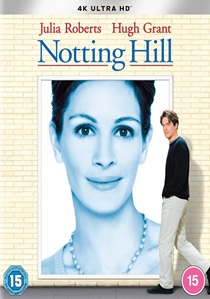
 4K UHD
 William Thacker is an ordinary London bookseller whose life is turned upside down when famous Hollywood actress Anna Scott walks into his Notting Hill shop. A chance encounter soon develops into an unlikely romance, but as their very different worlds collide, William discovers that falling in love with one of the most famous women in the world is anything but simple.

Details
William Thacker (Hugh Grant) leads a fairly unremarkable life in Notting Hill. Divorced, sharing his house with the eccentric Spike (Rhys Ifans) and running a travel bookshop which isn't exactly threatening Amazon's dominance of the market, his romantic prospects appear to be every bit as successful as his business.
Then Anna Scott (Julia Roberts) walks into his shop.
Unfortunately for William, Anna also happens to be one of the most famous film stars in the world, and she's not shopping for a book, merely avoiding the press. Their first encounter is brief, but a subsequent collision on the street - involving William, Anna and a freshly purchased glass of orange juice - results in her accompanying him back to his nearby house to clean herself up.
What follows is the beginning of an unlikely relationship between two people whose lives could hardly be more different. William gets a taste of Anna's celebrity lifestyle, while Anna finds herself increasingly drawn towards the considerably more ordinary world occupied by William, his family and friends.
Keeping their relationship private proves rather more difficult. Anna's fame means that wherever she goes the press are rarely far behind, while William soon finds himself considerably further inside her celebrity world than he ever expected - not on a potential date, but masquerading as a journalist from Horse & Hound magazine despite knowing precious little about horses, hounds or, indeed, the film he's supposedly there to discuss.
As their relationship develops, both must decide whether the differences between them are simply too great - or whether an ordinary bookseller and the world's most famous actress might actually have a future together.
Picture & Sound
More than twenty-five years after its original cinema release, Notting Hill finally makes the jump to 4K Ultra HD with a new 2160p presentation complete with Dolby Vision and HDR10.
For a film which spends so much of its running time wandering around one of London's most distinctive neighbourhoods, there's plenty of opportunity for the additional resolution and HDR presentation to make themselves useful. Portobello Road provides an obvious showcase, with its colourful buildings, market stalls, shops and crowds amongst the most consistently pleasing images on the disc. Colours have plenty of life without becoming unnaturally vivid, contrasting nicely with the more subdued interiors of William's house and bookshop.
Love it or hate it, however, that pesky grain is very much present. In the brighter sequences I found it considerably less prominent and generally quite natural, but once the film moves into darker surroundings it becomes much more noticeable and, on occasion, rather distracting.
The opening credits are particularly problematic. Here the image can look pretty awful, with some horrendous grain and what appears to be pixelisation giving parts of the sequence an extremely coarse appearance. Some of this may well be deliberate and inherent in the way the titles were originally created, but that doesn't necessarily make it any easier on the eyes. At its worst, there are moments when it looks more like an 8-bit computer game than a 4K Ultra HD presentation.
Thankfully, once beyond the credits there's considerably more to appreciate. The level of fine detail can be excellent and William's travel bookshop is a particularly good example. Postcards and posters decorating the walls are clearly legible, while individual titles can easily be picked out from the spines of the many travel books lining the shelves.
That detail extends to the characters too. Skin tones remain pleasant and natural throughout, while close-ups reveal plenty of facial detail without making anyone look artificially sharpened. Indeed, at one point the UHD presentation is revealing enough for me to spot a stray hair on Anna's face. Somebody in makeup clearly needed a quiet word that day.
The darker interiors aren't quite as convincing, principally because the grain becomes considerably more prominent. Still, I'd much rather retain a natural, film-like appearance than see everything scrubbed clean with excessive digital noise reduction, but there are undoubtedly occasions when it becomes more intrusive than I'd personally like.
Overall, it's an impressive upgrade which can reveal a remarkable amount of information that would previously have disappeared into the background. It isn't consistently pristine - and nor should a film from 1999 necessarily be expected to look as though it was shot yesterday - but when everything comes together, there's no mistaking the benefits of the format.
The soundtrack has also been revisited, with the English-language track receiving a Dolby Atmos presentation.
Dialogue is crisp and clear throughout, remaining firmly anchored to the centre channel and perfectly intelligible even during some of the busier sequences. The surround channels are also put to use for ambient effects, particularly during the outdoor scenes around Portobello Road, helping the streets feel suitably busy without unnecessarily drawing attention to individual sounds.
It's when the music kicks in that the Atmos presentation really announces itself. Rather than remaining largely across the front, the songs expand to occupy virtually the entire soundstage, enveloping the viewer and giving some of the film's best-known musical moments an impressive sense of scale.
If anything, though, it can be rather too much of a good thing. Compared with the otherwise restrained nature of the mix, the music can become surprisingly overpowering, suddenly dominating proceedings rather than simply complementing what's happening on screen. It's an odd contrast: dialogue and ambient effects are handled with considerable subtlety, then a song arrives and everything suddenly becomes considerably larger - perhaps a little larger than it really needs to be.
Nevertheless, the clarity is excellent and there's certainly no shortage of presence when the music demands it. It's an effective Atmos presentation overall, although one which occasionally seems rather more enthusiastic about the soundtrack than I am.
Menu & Extras
Unfortunately, anyone hoping the arrival of Notting Hill on 4K Ultra HD would be accompanied by a substantial new retrospective package may be disappointed. The UK disc largely returns to the familiar collection of archive material rather than looking back at the film more than twenty-five years later.
Spotlight on Location is the most substantial of the featurettes and runs for around fifteen minutes. It's a fairly traditional behind-the-scenes piece, combining footage from the making of the film with interviews with the cast and crew discussing the story, characters and production. There's some interesting material here, particularly when attention turns to actually making the film in and around Notting Hill, although its promotional origins inevitably mean it doesn't dig particularly deeply.
Seasonal Walk on Portobello Road concentrates on the construction of one of the film's cleverest sequences, in which William walks through Portobello Road while the seasons - and a considerable amount of time - change around him. Unfortunately, whilst interesting, it's a little too brief and I would have liked considerably more detail on the process involved in producing one of the film's best moments.
There's also Hugh Grant's Movie Tips, which gives Grant an opportunity to apply his characteristically dry sense of humour to the business of making a movie. To be honest, it's not that interesting and can probably be safely filed under the "filler material" section.
The deleted scenes are rather more worthwhile, providing around twelve minutes of material which didn't survive into the finished film. Amongst them we get William's rather amusing attempt to tell his parents that he's dating one of the world's most famous actresses, Bernie trying to supply him with a replacement girlfriend, an extended scene where Anna is trying some of her lines with William, and some additional - and quite amusing - material involving Spike. Most interestingly, there's also an alternative ending which demonstrates that sometimes the right material really does end up on the cutting-room floor. And my God, thank goodness they went with the version in the finished film. It's considerably more effective and ensures this reviewer will suddenly find something in his eye.
Music videos are included for Elvis Costello's She and Shania Twain's You've Got a Way, while a photograph montage rounds out the UK package - the sort of classic DVD-era filler material that anyone collecting discs twenty-five years ago will remember only too well. They're harmless enough additions, particularly given how important music is to the film, but once again we're firmly in archive territory rather than receiving anything created especially for this release.
More frustrating is what's missing. A commentary featuring director Roger Michell, producer Duncan Kenworthy and writer Richard Curtis has accompanied previous releases of the film and is included on the US 4K edition, yet it's conspicuously absent here in the UK. Given that it brings together the film's director, producer and writer, its omission is particularly difficult to understand.
And the commentary isn't the only casualty. The US release also includes both the US and international theatrical trailers, neither of which has made it onto the UK disc. Individually these omissions might seem relatively minor, but together they reinforce the impression that the UK edition has received a distinctly cut-down selection of the supplementary material already available.
Unfortunately, that's not the only area where UK collectors appear to draw the short straw. The US release includes the film on both 4K Ultra HD and Blu-ray, together with a Digital copy, whereas here in the UK the 4K and Blu-ray editions are sold separately. Anyone wanting the flexibility of owning both formats therefore has to buy the film twice - and at considerably greater expense.
For a film making its debut on 4K Ultra HD more than a quarter of a century after its original release, that's disappointing. More disappointing still is the absence of anything substantial looking back at the film today. With director Roger Michell sadly no longer with us, a new retrospective featuring the surviving cast and crew could have made this feel like a genuine celebration of the film rather than simply another opportunity to recycle the existing supplements.
Ultimately, it's difficult to escape the feeling that UK collectors are being asked to pay a premium price for what is actually a rather bare-bones package. Yes, there are extras on the disc, but they're entirely familiar archive material and even then we're missing the existing audio commentary and trailers. Throw in the absence of the Blu-ray and Digital copies included with the US release and the value proposition becomes increasingly difficult to defend.
For a premium 4K release, that's simply not good enough. The film itself may have received the upgrade we've been waiting for, but the package surrounding it feels distinctly second-rate - and, considering what collectors elsewhere are receiving, more than a little like a slap in the face.
Overall
There's something wonderfully ridiculous about the central premise of Notting Hill. One of the world's most famous actresses walks into a small London travel bookshop, meets somebody and falls in love with them. It's an impossible and preposterous dream, and yet somehow it works. And it's probably a dream that quite a few of us have entertained at one time or another too.
A large part of that is down to Richard Curtis' script. William has absolutely no interest in becoming part of Anna's Hollywood lifestyle and, if anything, it's Anna who seems increasingly attracted to his far more ordinary life. For somebody who can apparently have almost anything she wants, William's world begins to look considerably more appealing than another film premiere or luxury hotel room full of flowers.
The dinner with William's friends illustrates that beautifully. Anna might be accustomed to premieres, luxury hotels and being recognised everywhere she goes, but here she finds herself sitting around a table competing for the final brownie with a group of people whose problems have nothing whatsoever to do with being a celebrity.
Hugh Grant is, of course, doing the awkward, slightly flustered Englishman routine which he had already perfected by this point, but William remains enormously likeable. Julia Roberts is equally well cast as Anna and, given her own level of fame at the time, playing one of the world's biggest movie stars probably wasn't much of a stretch. More importantly, she brings enough warmth and vulnerability to the character for us to believe that, behind all the premieres, hotels and attention, Anna might genuinely prefer the far more ordinary life she discovers with William.
The supporting cast is equally important. Rhys Ifans comes perilously close to stealing the film as Spike, while Emma Chambers brings enormous warmth to Honey. Gina McKee, Tim McInnerny and Hugh Bonneville help create a group of friends who feel like people William might actually have known for years rather than characters assembled purely to provide the romantic leads with somebody to talk to.
There's also rather more melancholy running through Notting Hill than its reputation as a fluffy romantic comedy might suggest. Behind the jokes are failed relationships, loneliness, disappointment and people quietly wondering whether life has turned out quite as they'd expected. It's something that a lot of people can probably relate to.
The seasonal walk through Portobello Road remains one of the film's loveliest sequences. With Ain't No Sunshine playing on the soundtrack, William simply walks through the market while the world - and an entire year - changes around him. It's an elegant piece of filmmaking which communicates considerably more than pages of dialogue could have managed.
And then there's the ending.
For all the grand romantic gestures which precede it, my favourite moment might actually be the simplest. As the camera moves past William and Anna sitting together on the bench, Anna is revealed to be pregnant. There's no dialogue, no fanfare and no need for either. In a few seconds we're shown that the unlikely relationship we've spent two hours following didn't merely survive - it became a life together. It's a wonderfully understated way to end the film and one I've always found surprisingly emotional.
More than twenty-five years later, Notting Hill remains one of those romantic comedies where knowing precisely where everything is heading doesn't really matter. Its success lies in the journey, the characters and Richard Curtis' ability to find something melancholy sitting immediately alongside something very funny.
The 4K release may have been an opportunity to do considerably more with both the supplementary material and the package itself, but ultimately it's the film which matters. William's travel bookshop may have struggled to attract customers, but Notting Hill itself has proved considerably more successful at keeping an audience.
And, thankfully, you don't need to be the world's most famous actress to enjoy it.
Special features
- Spotlight on Location
- Seasonal Walk on Portobello Road
- Hugh Grant's Movie Tips
- Elvis Costello "She" Music Video
- Shania Twain "You've Got a Way" Music Video
- Photograph Montage

![The Fast and the Furious 25th Anniversary [4K Ultra HD] Limited Edition Steelbook](/adverts/amazon_furious.png)