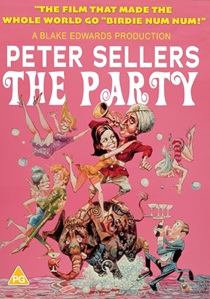
 Blu-ray
 After accidentally destroying an expensive Hollywood film set, bumbling actor Hrundi V. Bakshi is supposed to be blacklisted but is mistakenly invited to an exclusive party instead, where his innocent curiosity triggers an increasingly hilarious succession of mishaps and chaos.

Details
Hrundi V. Bakshi (Peter Sellers) is an Indian actor working on a lavish Hollywood period production, although his performance isn't exactly going according to plan. Playing a bugler during an elaborate battle sequence, Bakshi repeatedly refuses to stay dead after his character is shot, continually getting back up to play another note.
Things don't improve during another scene, when Bakshi finds himself fighting one of the enemy soldiers while wearing a very conspicuous modern wristwatch - hardly ideal for a film supposedly set in 1878. When the increasingly exasperated director points out that underwater watches hadn't even been invented at the time and casually asks him for the time, Bakshi instinctively looks at his wrist before suddenly realising his mistake.
Unfortunately, even that pales into insignificance compared with what happens next. While tying his shoelace, Bakshi accidentally triggers the explosives intended to destroy the enormous fort before the cameras are ready, demolishing an expensive set which can hardly be put back together for another take. It's the final straw for the furious director, who demands that Bakshi never works in Hollywood again.
His name is duly passed to studio head Fred Clutterbuck (J. Edward McKinley) to be added to the blacklist. Unfortunately, a clerical error results in Bakshi being added to a rather different list - the guests invited to an exclusive party at Clutterbuck's luxurious Hollywood home.
Oblivious to the fact that he shouldn't be there at all, Bakshi arrives at the party and attempts to mingle with Hollywood executives, actors and assorted members of high society. His intentions are invariably good; his ability to get through the evening without causing some form of disaster rather less so.
Amongst the guests is aspiring actress Michèle Monet (Claudine Longet), who quickly attracts Bakshi's attention. She's hoping to further her career in Hollywood, although the unwanted attentions of producer C.S. Divot (Gavin MacLeod) provide a rather less appealing glimpse of the industry she's trying to break into. As the evening progresses and the party descends further into chaos, Michèle and Bakshi find themselves increasingly drawn together.
Meanwhile, Bakshi's attempts to make himself comfortable become increasingly destructive. A lost shoe, an unfamiliar control panel and numerous other mishaps gradually transform Clutterbuck's carefully organised gathering into something considerably less sophisticated.
And that's before the elephant arrives.
Picture & Sound
Presented in 1080p and its original 2.35:1 aspect ratio, the transfer is something of a mixed bag, although given the age of the source material that's perhaps not entirely unexpected. The opening scenes on the Hollywood set are amongst the least impressive, with the image appearing quite noisy and grainy, while dust specks and other minor imperfections are frequently visible. It's certainly not pristine, but I doubt anyone is expecting too much from a nearly sixty-year-old film which hasn't undergone any extensive restoration.
Once the action moves to Clutterbuck's house and the party gets into full swing, however, the presentation is transformed. Colours become wonderfully rich and vibrant, with the elaborate 1960s décor, clothing and increasingly colourful gathering giving the image considerably more life. The stronger colours also go a long way towards disguising the grain, which becomes far less distracting than it is during the opening sequences.
Skin tones are presented about as naturally as you could reasonably expect from a film of this vintage, while the additional depth and detail afforded by the Blu-ray does an excellent job of portraying the surroundings of a well-heeled Hollywood party in the late 1960s. Clothing, furnishings and the extravagant interior of the house all reveal some pleasing detail without ever making the image look artificially sharpened. The only thing missing is a glass bowl and sets of car keys.
That sense of depth is particularly useful given Edwards' fondness for allowing several things to happen within the wide 2.35:1 frame at once. There's frequently something worth noticing away from the principal action, and the additional definition makes it considerably easier to appreciate both the production design and some of the comedy unfolding in the background.
Darker scenes are relatively few and far between, but when they do appear they're handled equally well. Blacks remain pleasingly rich rather than becoming washed out, while sufficient detail is retained within the darker areas of the image.
It's certainly not a pristine presentation, but once the party begins the rich colours, pleasing detail and additional depth make for a much more impressive image. Given that this is where the vast majority of the film takes place, that's ultimately where it matters most.
Sound is provided by a 5.1 DTS-HD Master Audio track and proves to be an interesting proposition. Dialogue isn't always as immediately discernible as you might expect, particularly once the party gets into full swing, with the band and music frequently occupying much of the soundscape and competing with the conversations taking place around it.
Initially, that might suggest a limitation of either the original recording or the transfer, but I'm not convinced that's the case at all. If anything, it feels quite deliberate. Edwards effectively places the viewer amongst the guests rather than giving us the artificially clean perspective of an outside observer. Just as at a real party, conversations have to compete with the band, the chatter of other guests and the general commotion taking place around them.
It becomes increasingly effective as the evening descends into chaos, with music, conversations and assorted noises all competing for attention. Rather than simply watching Clutterbuck's increasingly out-of-control gathering from the safety of the sofa, there's a genuine sense of being somewhere amongst the guests as everything gradually falls apart around you.
More importantly, The Party isn't particularly dependent upon dialogue in the first place. So much of Sellers' performance and Edwards' comedy is visual that occasionally having to concentrate a little harder on what somebody is saying doesn't detract from the film. If anything, the deliberately busy soundtrack complements the chaos unfolding on screen.
Menu & Extras
Thankfully, Final Cut hasn't simply dusted off The Party and sent it back out on Blu-ray without any supplementary material. The release retains a worthwhile collection of archive extras examining both the film itself and some of the people responsible for making it.
The most substantial is Inside the Party, a documentary running for around twenty-four minutes which looks back at the making of the film and the creative partnership between Peter Sellers and director Blake Edwards.
Perhaps even more interesting from a filmmaking perspective is The Party Revolution: A New Technology. Running for around sixteen minutes, it explores the pioneering production methods employed on the film and the use of video playback technology which allowed Edwards and his team to review material immediately after it had been shot - something which sounds completely unremarkable today but was decidedly less so in 1968.
It's particularly relevant to a film such as The Party, where improvisation played such an important role and became fundamental to the way the original screenplay was expanded during filming. With Edwards working from an unusually short script, the ability to immediately review what Sellers and the other performers had just done allowed for continuity, plus new ideas and routines to develop as filming progressed.
The remaining material consists of individual profiles of director Blake Edwards, producer Walter Mirisch and associate producer Ken Wales. They're considerably shorter pieces, but together provide some additional background on three of the people responsible for getting The Party onto the screen.
There's nothing newly produced for this 2026 release, but it's nevertheless good to see Final Cut retaining these archive supplements rather than simply issuing the film on its own. With the previous Eureka Blu-ray now out of print, its continued availability makes this a considerably more attractive proposition for anyone discovering the film on Blu-ray for the first time. Furthermore, the extras are genuinely interesting and, somewhat surprisingly, more useful and extensive than those accompanying some far more modern releases.
Overall
There isn't actually much of a story to The Party. Hrundi V. Bakshi is invited somewhere he shouldn't be, arrives at a house full of people he doesn't know and, over the course of the evening, virtually everything that can go wrong does. And that's really all Blake Edwards and Peter Sellers need.
Perhaps the most striking thing about The Party is just how little dialogue it actually needs. There is a screenplay, albeit an unusually short and deliberately loose one, but much of the comedy is almost entirely visual. Edwards frequently places the camera somewhere and simply allows Sellers to occupy the frame, with a look, a pause or the gradual realisation that Hrundi has done something he probably shouldn't providing the punchline.
That loose approach wasn't accidental. The screenplay reportedly ran to little more than sixty pages and contained considerably more description of the action than conventional dialogue, while Sellers and the other performers were given considerable freedom to improvise. The film was also shot largely in sequence, allowing ideas and running jokes to develop as the production progressed.
The result is wonderfully unpredictable, with Sellers frequently appearing to be exploring the house at exactly the same time as Hrundi. Sometimes we're simply watching him looking at something, deciding whether he should touch it and knowing full well that he inevitably will. Some of the film's most memorable routines grew considerably beyond what had originally been written, and there are moments when it really does feel as though Edwards simply pointed the camera at Sellers and told him to go for it.
It's perhaps even more remarkable given the famously turbulent relationship between Sellers and Edwards. The pair had enjoyed enormous success together with The Pink Panther and A Shot in the Dark, but their creative understanding wasn't necessarily matched by an equally harmonious working relationship and, after frequently clashing during the latter, they went their separate ways.
The Party brought them back together several years later and it's easy to understand why, despite their differences, the partnership was so difficult to leave behind. Both shared a love of the great silent comedians and, creatively at least, seemed to understand exactly what the other was trying to achieve. Edwards knew when to simply stand back and allow Sellers to develop a routine, while Sellers had a director who understood that sometimes a look, a pause or a perfectly timed piece of physical comedy was considerably funnier than another page of dialogue.
That doesn't mean everything was suddenly harmonious behind the camera - their relationship would remain famously difficult - but the results on screen demonstrate just how productive that occasionally combustible partnership could be.
It's tempting at first to see Hrundi as another variation on Inspector Clouseau. After all, this is Peter Sellers working with Blake Edwards and playing another well-meaning character with an extraordinary ability to leave chaos behind him. Yet the two are rather different. Clouseau generally causes destruction while remaining supremely confident that he knows exactly what he's doing; Hrundi approaches the unfamiliar world around him with almost childlike curiosity and usually causes disaster simply by trying to fit in.
That distinction becomes increasingly important as the film progresses. Sellers isn't relying upon pages of dialogue or even conventional jokes, with much of the humour instead coming from the physical performance and the way Edwards allows each situation to develop at its own pace. It's an approach which owes considerably more to the great silent comedians than to a conventional 1960s Hollywood comedy.
The lost shoe is a perfect example. It's an extraordinarily simple idea which Sellers and Edwards allow to develop at its own pace, with Hrundi desperately attempting to retrieve it without drawing attention to himself and, inevitably, achieving precisely the opposite. The same applies to the control panel, the toilet-roll sequence and the immortal "Birdie Num Num" (which is something I annoyed a friend with for years!). None requires complicated dialogue; once Sellers starts the routine, watching the inevitable disaster unfold is more than enough.
For all Sellers' brilliance, however, there's one member of the supporting cast who comes remarkably close to stealing the film from under him. Steve Franken is absolutely wonderful as Levinson, the increasingly drunken waiter who somehow becomes less capable of standing upright with every appearance while simultaneously retaining an almost supernatural ability not to spill the drinks he's carrying.
As the evening progresses, simply spotting him staggering into the background becomes funny before he's actually done anything. There are moments when Franken virtually walks away with the entire film - albeit rather unsteadily. Quite how he manages to become progressively more drunk while apparently never spilling a drop remains one of the evening's great mysteries.
There is, of course, one aspect of the film which is impossible to ignore nearly sixty years later. Sellers is a white English actor playing an Indian character, complete with darkened skin, accent and mannerisms. It's a portrayal which unquestionably belongs to another era and one which simply wouldn't be approached in the same way today.
Yet there's also an important distinction worth making. For all the stereotypes surrounding the performance, Bakshi himself isn't presented as stupid, unpleasant or someone we're encouraged to dislike. If anything, he's one of the most likeable people at the party. He's unfailingly polite and good-natured, while many of the supposedly sophisticated Hollywood guests surrounding him prove considerably less so.
There's also a rather sweet relationship which gradually develops between Hrundi and Michèle. Neither seems particularly comfortable amongst the Hollywood crowd and their shared position slightly outside proceedings gives the film some warmth amongst the escalating chaos that surrounds them.
It's difficult not to admire the sheer construction of some of the comedy too. Edwards frequently lets the camera sit back and allows a gag to develop within the widescreen frame rather than constantly cutting around Sellers. It means there's often something happening elsewhere in the picture, and occasionally the funniest person in the room isn't even the one we're supposed to be watching - particularly the waiter.
By the time the party finally descends into complete anarchy, restraint has long since left the building. What begins as a sophisticated Hollywood gathering eventually involves drunken guests, music, bubbles, foam and an elephant, by which point trying to explain precisely how everybody got there seems rather beside the point and even more confusing to explain.
Inevitably, some elements of The Party have aged better than others, but Sellers' command of physical comedy remains remarkably difficult to date. A glance, a pause or the smallest movement can be every bit as funny as the enormous disasters happening around him. Rowan Atkinson has acknowledged Peter Sellers as one of his influences when developing his own comedy, so it's not difficult to see some of that comic DNA here which would later resurface in one of comedy's most universally recognisable characters - Mr Bean.
More importantly, Hrundi V. Bakshi emerges as considerably more than Inspector Clouseau with a different accent. There's an innocence and gentleness to the character which makes him enormously likeable, even when virtually everything he touches appears destined for destruction.
For anyone who missed Eureka's now out-of-print edition, Final Cut's release provides another welcome opportunity to add one of Peter Sellers' most distinctive comedies to the collection, while retaining the worthwhile archive material which helps put its unusual production into context.
Just remember: if Hrundi V. Bakshi ever appears on your guest list, check the spelling before you send the invitation. And who the catering staff are.
Special features
- Inside the Party Documentary
- The Party Revolution: A New Technology Featurette
- Blake Edwards Profile
- Walter Mirisch Profile
- Ken Wales Profile