 DVD
DVD  Blu-ray
  4K UHD
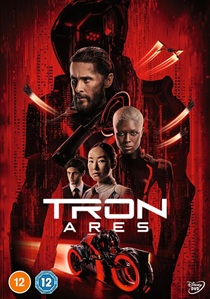
 TRON: Ares, the electrifying next chapter of Disney's seminal TRON franchise, expands upon the enduring legacy of its groundbreaking predecessors TRON (1982) and TRON: Legacy (2010) and explores what it means to be human when the digital and real world collide. The explosive action-adventure is directed by Joachim Rønning and stars Jared Leto, Greta Lee, Evan Peters, Jodie Turner-Smith, Hasan Minhaj, Arturo Castro and Cameron Monaghan, with Gillian Anderson and Jeff Bridges. Sean Bailey, Jared Leto, p.g.a., Emma Ludbrook, p.g.a., Jeffrey Silver, Justin Springer, p.g.a. and Steven Lisberger produce, with Trent Reznor & Atticus Ross, Russell Allen and Joseph Kosinski serving as executive producers. The screenplay is by Jesse Wigutow, with story by David DiGilio and Wigutow, based on characters created by Steven Lisberger and Bonnie MacBird. Nine Inch Nails composed the Original Motion Picture Soundtrack.
In TRON: Ares, a highly sophisticated digital Program, Ares (Jared Leto), is sent into the real world on a dangerous mission, marking humankind's first face-to-face encounter with artificial intelligence. As Ares experiences his surroundings and has his first brush with humanity, his consciousness - and conscience - start to evolve. He finds an unexpected ally in the brilliant technologist, computer programmer and current ENCOM CEO Eve Kim (Greta Lee), who is on her own journey to discover a critical code written by Kevin Flynn (Jeff Bridges). Betraying orders and relentlessly pursued, the two fight not only for their survival but for a future where technology and humanity can intersect.
A Return To The Grid
For Norwegian-born director Joachim Rønning (Pirates of the Caribbean: Dead Men Tell No Tales, Maleficent: Mistress of Evil, Young Woman and the Sea) and the filmmaking team, the key to approaching TRON: Ares was to uphold the cherished legacy already celebrated by generations of dedicated fans around the world, and introduce new audiences to the timely, technological spectacle that embodies TRON.
"The bar was really high," Rønning explains. "I wanted to design something new, but familiar. What drew me to the project was the mix of the digital and real worlds. Having a Program exist in the real world was interesting for me - I hadn't seen that before. And the idea of Ares finding out what it means to be human, what it takes to be human, was fascinating."
It was also critical that the story have a strong emotional core. Rønning says, "It needs to resonate with me on an emotional level, needs heart. I need to get that right to be interested in these characters, I need to connect with them. Although it's about an AI program that goes rogue, I'm not so interested in the AI aspect of this story. For me, it's about Ares' journey and discovering what it means and what it takes to be human. That's what it's all about, trying to answer those questions."
"The themes of 'TRON' are so contemporary," producer Justin Springer (TRON: Legacy, Oblivion) adds with a hint of optimism. "Ares shows more humanity than the human who created him. That is Ares' journey. The story between him and Eve is one of companionship and understanding. It suggests there is a way in which humans and artifcial intelligence can learn from one another, hopefully coexist."
Springer points to the scene when Eve first discovers that Ares is a Program and reacts with compassion as an example. "This is the moment when Eve first realizes that a Program as sophisticated as a human can exist in our world," he says. "She reaches out; she doesn't recoil. It's a sign of optimism in our relationship with technology. The technology is here, it's happening, and it's rapidly growing; it's not something we can put back in the box. We have to figure out how to create a better future for ourselves."
It was clear to producer Sean Bailey (TRON: Legacy, Gone Baby Gone) that Joachim Rønning was the perfect fit to direct. "Joachim is a really thrilling director," he says. "He has the ability to make films that have incredible scope, scale and energy, but which also focus on human elements, whether that be the joy of interaction and human rapport or really deep, fundamental emotions. If you look at his body of work, it really evidences that."
"Joachim Rønning was such a great choice for this movie," agrees executive producer Russell Allen (The Lion King, The Little Mermaid), "because he's a perfectionist when it comes to visuals and shot composition, which are hallmarks of the 'TRON' franchise. And he also brought a sensitivity, a sense of drama, and a sense of comedy to it, which rounded out the movie. He found a great balance between honoring the original films and bringing the franchise into the current day. He was a great collaborator; it was just really satisfying to be in the room with him."
According to producer Jeffrey Silver (The Lion King, The Little Mermaid), "'TRON' is a Pinocchio story. It's the tale of a flawed character and how he evolves to become a person, learning the intangible ways of the heart and the ephemeral nature of life. And there's a curiosity we have about what a mind is, and the closest metaphor we have for it in the modern world is the computer. Whether we view the world of computing as intrinsically physical - a brain - or metaphysical - a mind - the computer offers analogous meaning. Ultimately, 'TRON' explores what it means to be human, to have empathy, to be finite."
The undeniable impact of the original "TRON" films is in part thanks to the pioneering filmmaking technology used and an edgy, innovative connection back to the zeitgeist. That meant there were key elements filmmakers needed to keep top of mind for TRON: Ares. The stakes needed to feel heightened, the technology needed to be groundbreaking, and the story needed to feel relevant.
As producer Sean Bailey puts it, "the fascination with these films is the ambition of the ideas, both from the perspective of the plot and of the filmmaking. The technology Steven Lisberger and his team pioneered changed how films could be made. They changed everything that came after."
Bailey adds, "With 'TRON,' you're obligated to do a few things: you have to say something about the future, you have to technologically innovate, and you have to explore our relationship with technology. Whenever I would say to people in the early days of this film, 'Imagine the light cycles but at a 130-mph chase on a freeway,' everybody's eyes would get big. From a visual perspective, we are saying something very new. And the ideas this movie is exploring in terms of technology and our relationship with it is also very exciting."
That TRON: Ares has something new to say is upheld by the franchise's creator. "You know," says Steven Lisberger (TRON, TRON: Legacy), "today's audience often complains that movies are no longer radical enough or experimental enough or creative enough. I don't want to hear that about this movie. This is a highly experimental film! Sure, its lore goes back to 1982, but 'TRON: Ares' goes so far past that."
Meet The Cast Of Tron: Ares
The exceptional cast is led by Oscar(r) winner Jared Leto (Dallas Buyers Club, House of Gucci), who plays Ares, a highly trained, proficient Program created by Julian Dillinger and the most sophisticated security Program ever developed. When sent into the real world on an important mission, Ares' interactions with humanity lead him to question his allegiance. Ares, like all of Julian Dillinger's security Programs, self-destructs after only 29 minutes in the real world. As his priorities shift and loyalties change, finding the permanence code that will allow him to fully exist in the real world becomes his new objective.
As such, it was crucial Leto's performance as Ares be true to the digital world of TRON, and still capture nuanced emotional development. Leto's steadfast admiration of TRON was the initial key.
"It's exciting to have somebody at the centre of your film who's very committed to it," says producer Justin Springer. "The original movie was such an important, informative experience for him and quite beloved. For Jared to now step into that universe is very exciting. You feel it on screen. You feel his passion for the franchise."
Leto agrees. "I'm a 'TRON' super fan," he explains. "I'm all in on 'TRON.' I love 'TRON.' I always did. It captured my imagination, and it showed me a world I never imagined before. It was this combination of technology and creativity that really attracted me."
Leto first read a version of a script for a sequel to TRON: Legacy nine years ago. Though he wasn't available to come onto the project at the time, a minor character resonated with him. He went back to the filmmakers and explained that if they were, "ever interested in developing a movie around this character, I would be really interested." In 2016, he joined the production as a producer on the film and development on the current iteration focusing on Ares continued.
There were several complicated conversations early on about who and what Ares would represent. "Figuring out who Ares is was a very difficult task," says producer Emma Ludbrook (WeCrashed, American Gigolo). "He's a Program. So how does one convey a Program without it feeling stiff or one note or robotic. If you look at other films where people have played a robot, it can feel one dimensional, but Jared brings humanity to Ares. And we shot this movie out of order, so Jared had to keep track of Ares' journey from a weapon of mass destruction to a human being, a user, a real-life person. That was a challenging task, but he was so well studied as to who his character is, what this movie means, and how it fits into our world. I admit, I'm biased about Jared, because we've worked together for nearly two decades, and I know how much he just cares about this one. He worked so hard, not only to get this movie made but during shooting. Every step of the way he was a fantastic partner."
As Leto puts it, "Ares was always a tough nut to crack. He is basically artificial intelligence. And what's been really cool is a lot of the ideas and the things that we have been thinking about for the past nine years have come true sooner than we thought they would. The film is pretty timely in that way. It explores the future of technology. That's been pretty cool to see."
Greta Lee (Past Lives, The Morning Show) joins the cast as Eve Kim, one of the world's most talented programmers and the reclusive CEO of ENCOM, the massive tech company once headed by Kevin Flynn. Focused and full of heart, analytical and observant, Eve has her sights set on a world-changing technology - Flynn's hidden Permanence Code - so she can carry on her sister's legacy and bring about a greater good. She will stop at nothing to see it through.
Producer Emma Ludbrook notes, "Eve is a brilliant programmer, but she's also a brilliant human being who's had a lot of life experience that has brought her to the place she is."
When it came to casting Greta Lee, Ludbrook explains that she "was the only person we considered for this movie, but she turned us down. We went back to her and said, 'You're really the only person that can do this.' And we were right: she's so perfect in this role. I think what summed it up for us was when we watched her and Jared in the scene at the end, where they're leaning against the car and talking, taking it all in, and it's just such a good partnership. You really feel they've been on a journey together and are connected at the end of it."
Once Lee's schedule aligned, she was officially cast. She explains, "I love Eve Kim. I remember the first time I read the script, I couldn't believe that this character exists. The idea that I would have a chance to play her within this world was... I am getting tingly just thinking about it. Because the thing with her is, she's human. In a lot of ways, she's just a regular person. Yes, she's one of the world's most talented programmers. But I really love playing characters that are regular people faced with extraordinary circumstances, and they have to become superhuman in a way. And that's absolutely Eve Kim."
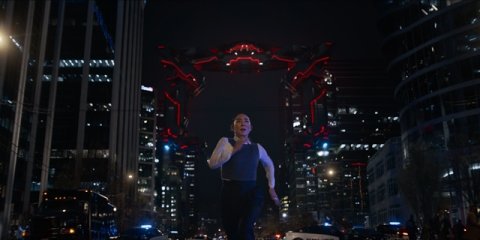
It was also a fun and challenging experience portraying a character so unlike any of her previous roles. "This movie and role, in a lot of ways, is the complete opposite to anything I've ever done," Lee explains. "I've never been part of a franchise like this, and I've also never been part of an action thriller. And getting to do my own stunts is incredibly physical, probably more physical than I anticipated when I signed up for it. So much running!"
Eve's character is also reminiscent of the character of Lora Baines played by Cindy Morgan in the original "TRON." "Something that I think never gets emphasized enough," says Steven Lisberger, "is that a woman was one of the main programmers at ENCOM. She navigated the system for the other guys. That was 1982. A woman as a key programmer - talk about suspension of disbelief or a bridge too far. For 20, 30 years, nobody believed that was possible. So, I really like the idea of Greta's character being who she is in this film. It's amazing. It's beautiful."
"Greta Lee has a sense of humour and yet she's very grounded," adds producer Justin Springer. "She's the proxy for the audience: she's the one falling into the world of 'TRON,' only the third human to ever exist inside the machine after Kevin and then Sam Flynn; she's the one who first realizes that a Program as sophisticated as a human is in our world. She's our eyes and ears, our perspective. So, to have somebody who's really grounded in the world and her character was tremendously important to us."
Evan Peters (Monster: The Jeffrey Dahmer Story, American Horror Story) stars as Julian Dillinger, a driven, ambitious and brilliant computer programmer who is singularly focused on pushing technology to the brink to establish his own legacy. The grandson of the late Edward Dillinger and the son of Edward's heir and successor, Elisabeth Dillinger, Julian has aspirations greater than that of his predecessors combined. Unfortunately, while his ambitions are great, his maturity is lacking. "Julian is the young CEO of Dillinger Corporation," says Evan Peters. "He's been given the job by his mother, and he's on an insane quest to achieve something great for the company. He's a brilliant programmer - he would call himself a genius - but his move fast, break things approach can be really dangerous."
"Julian is a cautionary tale," says screenwriter Jesse Wigutow. "He sets off with interesting, ambitious ideas but gets lost in greed and desire. He represents the dangers of the capitalistic side of AI."
Peters' performance captured the mercurial energy of the character perfectly. "[He] brings an interesting, old school, almost berserk energy to your classic antagonist," explains Wigutow. "I think of him as a kind of Eminem meets Kendall Roy. He really explodes off screen. It was really fun to watch."
As Evan Peters tells it, director Joachim Rønning "was very interested in playing around with Julian. Joachim suggested an unpredictable manner mixed with a strained relationship with the mother: he could be a mama's boy in one scene and in the next be this maniacal, driven madman who would do anything, even commit murder. It was a real opportunity for me to play a whole personality range in one character. I was definitely intrigued."
Jodie Turner-Smith (Queen & Slim, White Noise) joins the cast as Athena, Ares' second in command. Imposing, calculated, officious and driven solely by her programming to fulfil any directive without question, Athena is a member of an elite special forces unit of Programs created by Julian Dillinger and Dillinger Corporation. With incredible power and the inability to fear or doubt, Athena is a nearly unstoppable force.
Turner-Smith was excited to play such a strong and singularly focused character who experiences her own journey of discovery. "Athena is hardcore, she's a badass, which is very cool to do, and very interesting. She really is taking on that directive to be this super soldier, but also there's a part of her deviating from the plan. There is an experience that all of these Programs are having - they are being made and remade, experiencing death, pain, war, seemingly expendable."
"I think it's always fun when a character represents more of the chaos," Turner-Smith continues. "In her own way, Athena is the chaos that can come when nuance is unable to be interpreted. And that's Athena's struggle throughout the movie, interpreting nuance while she's having this experience that is changing her."
"The tragedy of her character," agrees producer Justin Springer, "is that while Ares sees another way and realizes that his purpose isn't his programming, Athena never quite makes it that far."
While Ares' experiences with humanity help him evolve down a path that explores what it means to be human, the opposite is true of Athena. "Athena's response to the world is going down a certain path," Turner-Smith explains. "She's sticking to the programming. And she's very absolute on her journey to fulfil that. When you have that kind of absolutism, that also means that you might want to override what your programmer is telling you to do."
"Also, just in a mechanical sense, it's not easy to wear those suits," she adds with a laugh. "I applaud everyone."
"Jodie is an action superstar," says producer Emma Ludbrook. "She worked out like crazy, was prepared for every action scene, and did all her own stunts, which not many actors do. She just always brought it. She's the perfect Athena. She took what could have been a cardboard villain and gave her an arc. She gave her emotion. She gave her feelings while still maintaining that she's a Program and never achieves humanity. She's really incredible in this movie."
Leto agrees. "Jodi Turner Smith is fantastic," he says. "I love her. She's a great actor and really a lot of fun to work with."
Ajay Singh, played by Hasan Minhaj (The Morning Show, It Ends with Us), is Eve's business partner and CTO of ENCOM. Ajay is the near opposite of Eve in personality, relishing his role as the showy face of the company. He basks in ENCOM's success - success that's largely thanks to Space Paranoids, the video game Kevin Flynn (Jeff Bridges) created but Eve perfected, and which made her and ENCOM very rich. While Eve is focused on her mission, Ajay takes the stage at Paranoia-Con, the massively successful convention for all things Space Paranoids, just as ENCOM is hacked by Julian Dillinger.
"Unlike Eve, who is a more grounded, humble leader," says Hasan Minhaj, "her old college roommate and partner, Ajay, happily plays the role of tech celebrity in a way that she's uncomfortable with."
"For someone like me as a performer," Minhaj continues, "I've spent a lot of time in comedy, political satire, talking about big dense subject matter. And Joachim wanted me to satirize and skewer the big tech oligarchs that we often see in the news. So, Ajay is kind of overeager and excited, and very proud of his company, and kind of likes the wealth and the cash that comes with technology. But he has a soft spot deep down and that's why he's so close with Eve."
While Minhaj was the filmmakers' first choice for the role, the 2023 SAG-AFTRA strike cast momentary doubt on his availability, and it wasn't clear they would be able to get him back. Luckily, they did, for as producer Justin Springer puts it, "he brings a great energy, a great comedic sensibility. He's just a really good actor; his dramatic scenes are really on point and bring a lot to the movie, and he gave us great banter. When we were writing the part of Ajay, it felt like Hasan's voice was always coming through. We were very grateful to get him to play the part."
For Minhaj, it was also impactful to see the ways in which TRON: Ares connects back to the earlier films. "One of the things this film approaches in a really beautiful way is how far can technology go before it goes too far, and the degree to which human beings and their reliance on technology should be measured or guarded against. And I think one of the best themes in the entire series, whether it be the first 'TRON,' or the second 'TRON: Legacy,' or now 'TRON: Ares,' is this really powerful allegory: it's a reminder that human beings should use the machines and not become the machines."
Arturo Castro (Road House, The Menu) joins the cast as Seth, Eve's highly intelligent, loyal and entertaining colleague and friend. He is devoted to Eve and will follow her anywhere. "The relationship between Seth and Eve is like brother and sister," explains Arturo Castro. "He's incredibly loyal to Eve, and she has made him a better person, but when we first meet them, they've spent months in a Quonset hut trying to find the Permanence Code, he is not a cold-weather person, and he's done with microwaved burritos. He's at the end of his rope."
While the character of Seth is, "Eve's goofy sidekick," explains producer Emma Ludbrook, "he's incredibly intelligent. He definitely went to MIT or Cal Tech or something similar, and she couldn't survive without him."
Arturo is, "just so fun and funny," continues Ludbrook. "Every single person around him enjoyed their days with him on set. And if you look at his body of work, he can go from straight comedy to very serious and emotional, and he does that in our movie. [It's] really special with Seth and Eve. It's very heartfelt, even as they poke fun at each other. What Greta and Arturo brought to that relationship was so special."
When it came to being cast as Seth, Castro explains, "Jared [Leto] was instrumental in me getting this role. He had seen the trailer for Road House, and he threw my name in the ring. I'll always be grateful to him for letting me be a part of this. And he was such a cool, solid presence on set. He was very generous with me when it came to getting things right in a scene. He created this playground for us to make the characters really come alive. Getting to work with him was definitely a dream come true."
Gillian Anderson (Sex Education, The Crown) plays Elisabeth Dillinger, the mother of Julian Dillinger and the daughter of Ed Dillinger, the villain in the original 1982 TRON. Intelligent, impeccably dressed and a seasoned leader in tech, Elisabeth Dillinger shepherded Dillinger Systems into its most prolific and profitable era. She has a complicated relationship with her son, Julian, to whom she's recently handed the company's reins over, as she sees the dangers of what he's creating. While he thinks this technology could change the world, she believes he may burn everything her family worked for to the ground.
"Elisabeth has experience and grace," says screenwriter Jesse Wigutow. "She's grounded. But she also fails to rein in her son until it's too late. She's the lens of the audience, watching AI unravel in front of her and not acting until it's gone too far."
"Elisabeth Dillinger is a very trustworthy, responsible human being," explains Evan Peters. "She's very loving in the way she's trying to teach her son, to enlighten him, to help him see that what he's doing is wrong. She understands him and she sympathizes with him - she's been there before herself - but she ran the company the right way. Maybe she didn't achieve a world-changing product like he potentially has done, but she nonetheless ran the company ethically and did a good job."
"I was interested where Elisabeth Dillinger fits in terms of the legacy of the story," Gillian Anderson says. "She's an important presence in this film because she carries the stakes. She helped build this company. She is part of the legacy and at the same time, she's fearful of the future. You see her for these short little snippets, but she is the embodiment of fear. Fear of what's going to happen to what they've built in the past. Fear for what her son is doing, fear for his safety. Fear for the safety of the planet and fear for the future of our company."
When it came to casting the inimitable Gillian Anderson, producer Justin Springer describes her as, "a great actress with a great legacy in the science fiction community." The part was initially intended to be played as Julian Dillinger's grandfather but was rewritten specifically for her. "We really wanted someone who could bring a forcefulness and a gravity to this world. And she delivered one hundred percent."
"She modelled her character on a number of matriarchs of organizations," adds producer Emma Ludbrook. "She was so thoughtful in how she brought Elisabeth to the screen and how the relationship with Elisabeth and Julian worked. It wasn't all on the page; she created that."
To the delight of fans, Jeff Bridges (Crazy Heart, True Grit) returns to the world of TRON as Kevin Flynn. One of the original computer geniuses, game developer Flynn broke new ground by pioneering the digital world of the Grid. In doing so, he turned ENCOM into an information superpower and then left without a trace in 1989, becoming trapped in the Grid-the world of his own creation.
"Jeff Bridges is the embodiment of the 'TRON' franchise," says producer Sean Bailey. "It just wouldn't have felt right not to have him in a critical role. It was just a tremendous thrill to be back making another one with him, to see him again on the Grid. It was really rewarding."
"The week that Jeff Bridges was ilming was the most exciting week on the movie," recalls executive producer Russell Allen. "The set was just buzzing. Jeff Bridges is 'TRON,' so to do a movie without him wouldn't have felt right."
Producer Emma Ludbrook adds, "Jeff Bridges could have asked for anything because Jeff Bridges was always going to be in this movie. He is the legend. And yet he didn't just show up and wing it; he really got back into the character of Flynn. He is an amazing actor, and yet he's so loose and comfortable on set. He's one of Jared's heroes. It was really a dream to have him; we're so grateful he said yes."
Bridges describes what it's like to return to the role of Kevin Flynn as being, "a bit surreal. 1982, 43 years ago, this thing started. And what a wild adventure it's been. It started off with a big bang with our Captain Steven Lisberger and wow, having done three 'TRON' films. Seeing the difference from the original to 'TRON: Ares' has been just phenomenal. Justin Springer, who was also involved with the first one and 'TRON: Legacy', we talked quite a bit. And Steven Lisberger, we chatted to find out what the story line was going to be, what we wanted to emphasize."
When it came to the fateful moment that Flynn and Ares meet inside Flynn's Grid, producer Justin Springer explains, "A programmer who has been lost in the virtual world since the mid- 80s stands before a highly evolved, modern AI program. One that is far beyond what Flynn imagined, and which he feared might one day be achieved."
"One of the things that Flynn brings to the story is a sense of wonder and curiosity that could form a different approach when it comes to technology," adds screenwriter Jesse Wigutow. "There's a lot of fear around technology, a lot of fear of the unknown. We're saying there's another way to approach this conversation. With a little more curiosity, we may learn from AI. We may perhaps discover a humanity that we don't have on our own."
Rounding out the cast is Cameron Monaghan (Shameless, Gotham) as Caius, a Combat AI Utility Software Program and member of Ares' elite Special Forces unit. When wounded in battle, he experiences an unpredictable act of loyalty from his commander.
A Closer Look At Production
TRON: Ares officially went into production in January 2024, and audiences may be surprised to learn just how much of the film was shot practically and captured in-camera.
Practical Sets and Shooting In-Camera Each Grid had its own unique practical set. Production recreated Kevin Flynn's original office in painstaking detail. Scenes set at Dillinger Corporation were filmed in huge hangars, and the action sequences were shot over the course of six-weeks of night shoots throughout the streets of Vancouver.
"For a film that is so much about technology," says producer Emma Ludbrook, "and which used technology so much to create it, we had these giant practical sets that were so vast you couldn't believe they existed in real life. Having a practical set versus a digital set is very different."
"You can feel it, especially in the light cycle sequence, that it's shot in camera. And I'm really proud of that. It's logistically hard," director Joachim Rønning explains. "I wanted to shoot as much as possible for real, in-camera."
"From the very beginning," says special effects coordinator Cameron Waldbauer, "our director, Joachim Rønning, wanted to do a lot of practical stuff. He had the thought that, if 'TRON' comes to the real world, practical things must happen, and you can have fun with that interaction. That gave us the opportunity to do a lot of interesting things, things that maybe you can't do in other films because they don't have the computer element behind the action."
ILM visual effects supervisor David Seager adds, "There was a high bar set by Joachim, by the history of 'TRON,' and by the fans. It would not have been visual-effects difficult - the technology is tried and true - it's the difficulty of meeting expectations. The light cycle chase, as an example, is one where, if we went down a path that was overly CG, you would feel that pretty soon. To me, 'TRON: Ares' hearkens back to more traditional action films, and that's really what takes 'TRON' in a new direction; it's a little bit outside the wheelhouse of what people typically think of as a 'TRON' film."
"We had shot 'TRON: Legacy' in Vancouver and had a wonderful experience," says producer Jeffrey Silver. "We have a special place in our hearts for the Vancouver crew, and I think they have for us too. They're a world-class team who gave everything their all. Returning for TRON: Ares was an easy decision. And they allowed us to shut down downtown for a really big chunk of time in a way that you probably can't do in most cities."
Location manager Anne Goobie was tasked with convincing the city of Vancouver to close several streets in the heart of downtown for hours every night while the light cycle chase scenes were filmed. "A lot of legwork for myself and my team to set that up," says Goobie. "We had closures from 7:00 p.m. until 6:00 in the morning. It's where we had our big destruction scene with the Super Recognizer. We had to put a lot of rubble on the street, and we had to figure out how to get it off the street by 6:00 a.m., while still giving the shooting crew as much time as possible. The shots also required extensive use of drones, which required approval from Transport Canada, and then approval from the city as to when they could be flown."
Downtown Vancouver also has a high population density, which provided additional safety challenges. "We were very concerned with the cycles going so fast," says Goobie. "When you're shooting such things, you have to make sure that every nook and cranny is covered, because if you don't, then someone might just decide to walk out a doorway right into the path of the bikes. We had 70 production assistants out there, 17 police officers, and two sergeants; it was like having a little army every night."
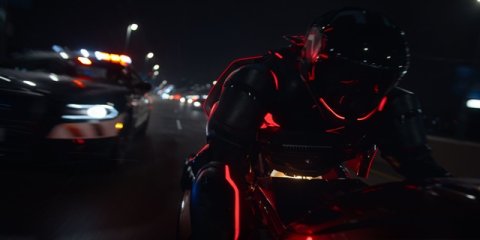
When the light wall from Ares' light cycle slices a police cruiser in half, it was no CGI stunt; this was a real cruiser the visual effects team painstakingly split into two. "That's all in- camera," says Rønning. "The amazing special effects team in Vancouver rigged five or six police cars that were pre-cut in half, then stitched them together. It's being pulled by a truck on a 100-yard wire to get up to speed and it's remote controlled. At a certain point charges in the middle of the car blow and split the car in half, and then Industrial Light & Magic comes in and creates the light wall going through it. I think if everything was CG, it could be great. But on a movie like 'TRON: Ares,' we owe the audience to at least try to do it. With that scene, we had to go back and close down the bridge one more time, and the second unit got [the car] to spread in the right direction. That's the dedication."
Even Julian Dillinger's office was built as a practical set complete with LED screens projecting footage of an active transfer bay below. "Outside his windows we had a projection wall and LED screens," says production designer Darren Gilford, "and we projected the transfer bay onto it. It meant we had to design every nut and bolt and piece of dressing within the bay so it could be rendered. ILM rendered it and projected it out the window, and it worked great. It meant I was able to design a set with that glossy desk and other interesting surfaces without having to worry about a bluescreen spilling colour in. It was complicated but worth the effort."
Designing Three Distinct Grids
Unlike the first two films, TRON: Ares takes place on three unique Grids: the ENCOM Grid, the Dillinger Grid and Flynn's Grid. Spearheaded by graphic designer Ellen Lampl, whom production designer Darren Gilford calls, "a graphics powerhouse," each Grid was made distinct from the other so as not to confuse the audience.
The design team chose the primary RGB colour scheme: "For the Dillinger Grid we immediately went to red," says Gilford. "Dante's Inferno. To complement that, ENCOM was green, like the Emerald City. And Flynn's Grid is the same blue as before: instantly recognizable to fans." Gilford also used visual metaphors to illustrate computer language: the security of ENCOM's system is visualized as a medieval castle, its firewall literally a giant firewall, and its data falls like droplets of light in a cathedral-like structure.
For the Dillinger Grid, says Gilford, "one of our gambles that ended up really successful was the texture of the walls. We didn't want to do traditional paint and surfaces like you'd see in the real world, and we ended up using a stainless-steel sheet called Dibond that we could bend, and we put a vinyl automotive wrap over it. It gave us this transparent candy apple red look, with the grain and light of the stainless steel visible through, which gave the walls a really interesting look. And when the light hit it, it really bounced and sang. And then we saw that, if the grain of the stainless steel was horizontal, the highlights would go vertical, and vice versa. So we started experimenting with angles, rotating the material to see how the highlights would kiss along each surface. It was really, really interesting and just gave a very different, unique look to the surfaces of the Dillinger Grid."
Light Cycles
"What the light cycle has always represented," says "TRON" creator Steven Lisberger, "is our relationship with technology: we got on it, it's beautiful, it's scary fast, and we've been hanging on ever since. I think that's one of the reasons the light cycle is so successful without blatantly declaring its meaning; it's a silent symbol for how we feel: that we're just moving so fast!"
"The light cycles are the crown jewel of the 'TRON' design legacy," says production designer Darren Gilford. "They have earned a place in movie vehicle lore that, like the Batmobile, are almost religious in nature. Syd Mead designed the original one, and when I began updating it, it felt like I was working on a religious artifact. There are certain things that make a light cycle, unwritten rules as to its visual cues, and you have to stay within those boundaries."
For TRON: Ares, proxy cycles were built on the frames of electric motorcycles with a lengthened wheelbase, custom necks, swing arms on the back, and practical light sources; these cycles were towed during live action shots. Then the team built gorgeous prototype light cycles that don't move; elements like hub-less wheels made them impossible to work in the real world. But making them seem as if they could work was the result of a team led by three key people: concept illustrator Haisu Wang; modeler, concept designer, and engineer Joe Hura, whose modelling in SolidWorks was so accurate that the designers were able to cut the exact parts of the light cycle from his model; and vehicle art director Rob Johnson, who turned art into function.
Once the prototype was perfected, the model was handed over to the builders, who used mostly milled aluminium. Picture-car coordinator Tom Katinic then provided his library of automotive finishes from all the major car manufacturers, from which colours were chosen and tested on pieces under different lighting conditions including no light at all: the cycles feature a stealth mode, where the lighting is dimmed or turned off entirely. The team's findings were then presented to director Joachim Rønning, who made the final choice.
"The challenge we faced with the light cycles was they were very low to the ground," says ILM visual effects supervisor David Seager. "Moreover, the posture of the riders is very forward, more so than a normal motorcycle; to get a shot of someone's face, the camera has to sit 18 inches off the ground. So we built an array that had a camera on the front bumper, the rear bumper, and multiple decks of cameras - 11 cameras in all. And since things like light cycles look cooler when the road is wet, even on dry days we wet down everything. But then if you put an array that low, you get spray on the cameras. So then we had to create a mechanism to protect the lenses from the spray. Bottom line is, by the time we were done, we had built quite a vehicle. We called it The Beast."
"It was ingenuous," says director Joachim Rønning. "The cycles really appeared to move. We had our actors on them, they tipped and turned, and you really got the shake, the realness of the ride."
As for the proxy bike, "we knew it wasn't going to be delicate work," says visual effects coordinator Cameron Waldbauer. "They were going to be driven downtown at 130 miles an hour, towed behind a truck in the rain. They were going to be on a green screen set, smashing together as they're battling down the street, and smashed into parked cars. You can't waste the production's time while they wait for someone to put parts back on the light cycle. So this thing was engineered from the ground up to be robust. There were 10,000 custom LEDs soldered inside, and we used a high-gloss automotive finish on them so they didn't get chipped. It was a lot of work, but I know everyone that worked on them is very proud. They're pretty cool."
Moreover, every single one of those LED panels could be controlled independently by the lighting department via a DMX board. This allowed for the lighting to be adjusted as demanded by the scene. It also allowed the lighting department to cut the lights to the bike immediately between takes, saving battery life.
Costume Design
The costumes in TRON: Ares were designed by costume designers Alix Friedberg and Christine Bieselin Clark. Friedberg designed the real-world clothing, while Clark designed the light suits.
For the real world, the focus was on removing the cold, graphic lines of the Grid to ensure the characters were relatable. "With Eve we turned to Japanese street style," says Friedberg. "The city of Harajuku is the centre of youth culture and style; it's very counterculture. This is the genesis of Eve before she got money. We tried to keep her rooted in that base and avoid that typical action-movie heroine in tight jeans, tank top, and tight black leather jacket; we wanted something different and unexpected. Her jacket is more of a café racer and a nod to a 70s/80s style but brought into our world. The white and blue in her jacket is so iconic, and it mimics her colours when she's taken prisoner in the Grid." Eve's jackets - all 13 of them - were custom made by Jonathan A. Logan in LA.
"For Seth," says Friedberg, "we gave a lot of colour to his character, because he is the comedic lightness of the movie and needed to be the visual manifestation of that as well." Seth is someone who has made a lot of money but doesn't know how to spend it; his clothes are basic and comfortable. And for those with a keen eye, at the end of the movie Seth wears a t-shirt printed with "reindeer fiotilla," Flynn's password.
As for Ajay, Friedberg explains that she "looked a lot at leisure wear and the revolution of sneaker culture, the look of tech CEOs these days. Ajay is a lot fiashier than Eve. He always wanted to be a billionaire, while Eve was always the quiet one who didn't want to be in the spotlight. We imagined Ajay would have a stylist to meticulously pick out his clothes, and so he ended up wearing a lot of very high-end pieces. There's a slickness about him we wanted to impart."
Ajay's nemesis, Julian Dillinger, is more understated, his clothes hiding the danger within. "The Dillinger world we kept similar to their Grid," says Friedberg. "Blacks and reds and other warm colours like orange, maroon, brown, and grey. We tried maybe three different iterations of Julian, exploring costume and hair and makeup before Evan really found who his character was."
When it came to designing a costume for Kevin Flynn, Friedberg says, "It's such an iconic look. He has this Buddhist/Japanese kimono style of dress, which is quite different from everybody else in the film. We took our inspiration in that silhouette and from the original lighting design of the '82 film - in that the characters are lit from within - and the original Moebius graphics. Thus, the shape of the heart on the front of his robe is an exact replica of what he wears in the '82 film, while the back of his robe has that same waterfall circuitry pattern." The pattern was laser cut through a bottom layer of fabric, with lights placed beneath that so as to shine through, effecting the look of a robe lit from within. A special 3D- printed sheet was made in a fiexible material that had more than 150 feet of LED strips installed.
Light Suits
The infamous light suits return in TRON: Ares, this time designed by costume designer Christine Bieselin Clark. As with the three Grids, the light suits were coloured according to their Grids: Ares's and Athena's suits are black, the Dillinger Grid guards are in red, and the ENCOM Grid guards are in grey (and fans may notice the ENCOM suits have the same hex pattern printed on them as found on the Grid in "TRON: Legacy"). More important than colour, however, was that the production was, "faced with the challenge of creating suits that appeared as though they were computer generated, but which also made sense and looked right in the real world," says executive producer Russell Allen. "And which had to be comfortable enough for the cast to wear them for up to 10 hours a day." The design team also had to consider the possibility of rain, how to keep the suits lit but without the risk of electrocuting anyone. To achieve their aims, the producers turned to Weta Workshop of New Zealand to build the suits.
"Our light suits are some of the most complex costumes in film history," says producer Jeffrey Silver. "Weta built them out of a molded polyurethane and illuminated LED panels. Each suit carried its own light source within a backpack-mounted 'TRON' disc and could be operated remotely from a dimmer board; each helmet also had its own power source. They had to look right while being sturdy enough to withstand daily rigorous stunt action."
Lans Hansen was the Weta art director on this project. His first priority was figuring out the wiring, as safety was a big concern, especially with the high level of stunt action. That meant using a low-voltage product - but with the lights still bright enough to be visible when shot in daylight - and a fiexible one that wouldn't stiffen the suits, rendering them uncomfortable and stunt work more difficult. That led Hansen to the Cob LED strip, with each suit featuring multiple strips running behind coloured diffusers. "The interesting thing we learned in some of the early camera tests," says Hansen, "is that, with the red lights, to the eye they all looked the same red, but to the camera, as the light became brighter or darker, it changed colour. We discovered that, when casting the diffusers, if one was so much as half a millimetre too thick, the light appeared pink. Half a millimetre too thin, and the light appeared orange. Quality control became essential to ensure they were all optically the same as each other."
The LEDs were powered with 12V batteries, which provided approximately thirty minutes at full brightness (so they timed out at about the same speed as the Programs and then, like the Programs, had to be replaced: life imitates art). All in all, Hansen used about three-quarters of a mile of LED strips across all the various suits.
For the suits themselves, they were built with five different urethane products of different degrees of hardnesses, with more fiexible parts through the leg, and more rigid components across the armour. These were all mounted onto a base layer of printed Lycra. Ares' suit had about 110 components cast from silicone molds; 18 suits, a mix of partial and complete, were built for Jared Leto and his stunt and photo doubles, with a total north of 700 pieces.
Across the two Grids, Weta built 62 suits in total, with the Vancouver team building the remaining 13 suits from parts supplied by Weta. Again, a mix of partial and complete suits were built, using approximately 7000 pieces in total.
Responsibility for the helmets was split between Weta and California-based Ironhead Studios, with Ironhead specializing in Ares' and Athena's helmets (11 in total), and Weta building the other 35 for the Grid soldiers. A further 13 light cycle helmets were made by Ironhead.
On top of that, there were 52 discs, 63 pairs of boots, and 35 batons made for the costume department, with props building their own specialized versions as well.
In New Zealand, Hansen had a team of about 75 people, and then a small team of four, led by Hansen, travelled to Vancouver to provide maintenance during the shoot. "'TRON' was a dream project for us," says Hansen. "It's one of the coolest, most iconic costumes that you could ever work on. It was amazing to be a part of that journey."
Executive producer Russell Allen applauds Christine Bieselin Clark's designs and Weta's skill in making them real. "We set ourselves a very high bar at the beginning of the movie with these light suits," says Allen, "in the design and to make them as practical as possible. Christine's designs are outstanding, and the high level of skilled craftsmanship Weta brought just knocked it out of the park."
"It was so interesting seeing Jared Leto in his amazing 'TRON' suit, lit up in the rain and the dark," says Rønning. "Seeing that contrast was important for me."
"I loved the suit," says Jared Leto. "It really gave me what I needed to bring the character to life. And when you wear that suit, you can't help but be transported. It feels like you're in the Grid. I mean, you look down, your whole suit is lit up. They don't do that in post. It was very heavy and painful at times, but worth it."
Light Disks
Perhaps as iconic as the light cycles and light suits are the light discs: keepers of personal data and lethal weapons. As with the Grid, the discs change colour and shape depending on who possesses them and the Program's position.
"A lot of thought went into that," says property master Dean Eilertson. "Hexagonal shapes were really big in 'TRON: Legacy,' and I tend to use them. There's no rhyme or reason to this;
I like the angles." When Ares, and later Athena, are made Master Control Program, they graduate to a rounded triangular black disk, illuminated with red lights. "We thought it would still feel like 'TRON' even if the MCP disc is a different shape. We decided that adding a special disc that wasn't round would tell the audience who is Master Control." And, Eilertson admits, "We thought it was cool."
The hexagonal shape of the soldiers' discs also differentiates them from Eve when she is captured and digitized onto the Dillinger Grid. Eve's disc is white and round, but "when Ares grabs it, it turns blue," says Eilertson. "The blue ring inside her disc looks like a million little microchips of information. That was something I really pushed hard on myself. I didn't want to have another opaque-looking disc. I wanted something more magical for her." When Ares later becomes human, his disc, too, turns white, and there is no longer an outer ring of energy, as there is with Programs.
Each disc had its individual power source that was remote controlled via a DMX board. "There were eight channels in it," says Eilertson. "So, when Ares was holding his disc up, we could light his face and have the re?ection in his visor, and we could light it incrementally, say 50% or 80% on his face and only 15% towards the lens so we didn't burn out the camera."
Designing the discs also meant liaising with costumes, as the discs had to be mounted on the back of the Programs' suits. "We actually took a ton of time figuring out the shapes and the proportions," says Eilertson. "Getting the triangular and the circular discs to feel about the same mass was surprisingly difficult; we had to play with everything from the size to the thickness. They went through so many different versions, many variations in scale, and we were chasing Jared around the world, sending him 3D printed ones. 'Is it big enough in your hand?' 'Do you like this?' We finally arrived at a decision and with that came a lot of information for us to work with."
There were both stunt and hero versions of the discs, and both body discs and fighting discs. To accommodate the speed of production, all the various discs were easily interchanged on the suits via a quick-release mechanism. "And if you look closely at the MCP disc," says Eilertson, "you will see that it is branded with the Dillinger logo as this is the Program Julian is trying to sell. And in the three corners there is a metal frame stamped Recognizer, an homage to the original film."
The baton was also updated from the TRON: Legacy version. "Our baton," says Eilertson, "this time around has a lot more functions. There is this little screen from which you can select what you want - be it a light cycle, a skimmer, a light jet, and so on - and the baton turns into that object."
The light disks are a critical part of the "TRON" universe. As creator Steven Lisberger explains, "In the original film, the ethos was to avoid handguns. It's not easy making a Hollywood action movie without handguns, but we pulled it off. I was not opposed to cannons, however. And there are tanks in the first film, because I wasn't worried that school kids were going to get their hands on a tank."
Production Design
While TRON: Ares forges its own path, the world of TRON, "has a very distinct visual style," says producer Sean Bailey. "People say, 'That looks like "TRON,"' or 'That sounds like "TRON."' You can't say that about many franchises out there." And key to developing that continuity was hiring production designer Darren Gilford and his team, who also designed "TRON: Legacy." "Darren Gilford is an immense talent," says Bailey. "He did 'TRON: Legacy' and JJ Abrams' 'Star Wars,' and he worked on 'Ascension' before it was shelved. I love Darren's ability to dream of and build the most massive environments but simultaneously pay attention to the smallest, most granular detail. When you see his worlds on screen, you feel the magnitude, but it also feels incredibly real and tactile."
"It is one of my great honours to walk in the footsteps of Steven Lisberger and Syd Mead, who was a childhood legend of mine," says Gilford. "And Moebius [conceptual artist Jean 'Moebius' Giraud]. And all the artists who established the first 'TRON.' To think that the styles and themes they established so long ago have in?uenced so many other stories all these years later is very inspiring. Having 'TRON: Legacy' come my way early in my career was a huge opportunity that I am very grateful for. And then I worked on the earlier iteration of this film. And now, ten years later, to come back to the same studio, the same country, with the same crew, was a real pleasure. It has been a decade-long journey."
"Darren took what came before and updated it," says producer Justin Springer. "Everything within that world, from the vehicles to the discs to the Grids, he gave it a new style. It's fresh and exciting without feeling outside of what everybody knows 'TRON' to be. He's been a great partner for a really long time on this franchise and has cemented his own legacy in 'TRON.'"
Executive producer Russell Allen concurs: "Darren Gilford is a genius. If there was a Mount Rushmore of people who understood 'TRON,' Darren would be on it, without question; he should be talked about in the same breath as Syd Mead. Darren poured 15 years of his life into 'TRON,' and you can feel the passion and the precision in everything he does."
Cinematography and Filming for IMAX
"'TRON' is all about light," says executive producer Russell Allen. "So the choice of DP was really, really important. We were super lucky and very excited that Jeff [Cronenweth] was available and said yes. Jeff's use of light, and his use of darkness, were really great additions to the 'TRON' aesthetic. Frankly I couldn't really imagine doing this movie with any other DP."
Jared Leto and Cronenweth had worked together on "Fight Club" and remained friends. When Leto asked if he would consider a sci-? film, something he hadn't done before, Cronenweth responded that it, "wasn't in my comfort zone." After he read the script and liked it, "we had a conversation about it. I said to Jared, 'I'm trying to understand Ares' perspective; is it like the ending of 'Blade Runner,' when Rutger Hauer and Harrison Ford are sitting on the rooftop, having that discussion about humanity and how valuable life is?' And Jared started reciting verbatim both roles in their entirety. And I said, 'sold'."
Cronenweth also credits director Joachim Rønning's clear vision and understanding of how to execute meticulous shots. "What sets Joachim Rønning apart," says Cronenweth, "is his passion for and knowledge of camera and camera movement. The way he uses the camera to tell the story. We had an incredibly talented camera crew, and together we came up with some incredibly complicated but informative shots. They were not always the easiest things to light, but the challenge was outweighed by the experience of the shot and the information garnered from them. It's just really good storytelling that's inclusive and exciting and original."
"When Ares comes to life," says Cronenweth, "it is very mechanical and precise, and so to mimic that we wanted to eliminate human movement in the camera. SISU makes these motion-controlled robotic arms, which allowed us to create incredible shots that would be almost impossible to do ourselves. This element of precision goes hand in hand with how the Program perceives the world and what its movements would be. It's about de?ning the language of the movie."
Cronenweth also used new camera technology to achieve his goals: "I shot a picture a few years ago where I used ARRI DNA lenses on a RED camera, and that hadn't really been done before; this time I wanted to use large-format DNA lenses from Aerofex with the RED V-Raptor 8K camera, and so Aeroflex and RED joined together to make the adapters and combine them for the first time. They even changed the colour pattern of the camera and put the 'TRON' logo on it to create a special edition just for this film."
The need for large-format lenses was due to the decision to shoot an IMAX version of the film, a first for director Joachim Rønning. "It was a privilege, I must say," says the director. "I love making films for the big screen, and it doesn't get much bigger than the IMAX. It was an amazing ride, discovering the format. Even just having the monitors calibrated to the IMAX format is very different; it felt almost as if I could step into the frame. A movie like this lends itself to the IMAX format; it is going to be such a treat."
For Cronenweth, shooting for IMAX, "added an element of prestige and responsibility. When the invite came, and once we embraced the idea of IMAX, we decided to shoot 8K, both for visual effects and to put our best foot forward in the format. And shooting 2.40 but protecting for 17:9 became very easy for us. I don't think either format was compromised at all." In fact, adds Cronenweth, "I think a scene that will blow people away in IMAX is the first light cycle chase. Ares and Athena burst out of Dillinger Corporation, find and locate Eve in the city, and then the chase takes place. Obviously, we've seen a lot of chases, but you haven't seen a chase like this with light cycles streaming light beams behind them or creating light walls. It's pretty spectacular."
Greta Lee agrees. "Jeff Cronenweth, our cinematographer, did a stunning job. The way it looks, it's so genuinely exciting."



![The Fast and the Furious 25th Anniversary [4K Ultra HD] Limited Edition Steelbook](/adverts/amazon_furious.png)