 DVD
DVD  Blu-ray
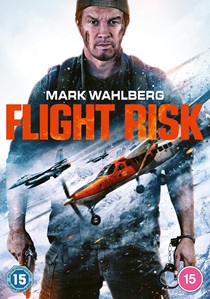
 In the high-stakes suspense thriller Flight Risk, Academy Award® nominee Mark Wahlberg (Best Supporting Actor, The Departed, 2006) plays a pilot transporting an Air Marshal (Michelle Dockery) accompanying a fugitive (Topher Grace) to trial. As they fly over the Alaskan wilderness, tensions soar and trust is tested, as not everyone on board is who they seem.
Flight Risk is directed by Academy Award®-winning filmmaker Mel Gibson (Best Director, Braveheart, 1995) and written by Jared Rosenberg. The film is produced by John Davis, John Fox, Bruce Davey, and Mel Gibson. The executive producers are Alex Lebovici, Jenny Hinkey, Vicki Christianson, Nick Guerra, Paul J. Diaz, Petr Jáckl, Ryan Hollander, Jon Huddle, Patrick Josten, Walter Josten, Jarrett Mahoney, Christopher Woodrow, K. Blaine Johnston, Ryan Donnell Smith, Natasha Stassen, and Allen Cheney.
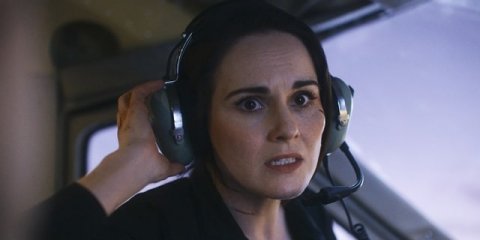
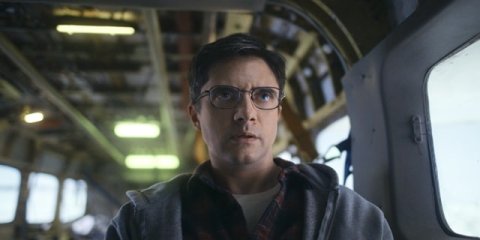
A thrilling and propulsive mix of high-octane action and psychological warfare aboard a small aircraft as it soars above the majestic vistas of the Alaskan terrain, Flight Risk opens as mob accountant Winston (Grace) is captured by U.S. Deputy Marshal Madolyn (Dockery) at a seedy motel. The next day, after Madolyn ushers Winston aboard the aircraft that will transport them to Anchorage - and ultimately the trial at which the newly minted government witness will testify - Winston complains endlessly at being shackled in his seat.
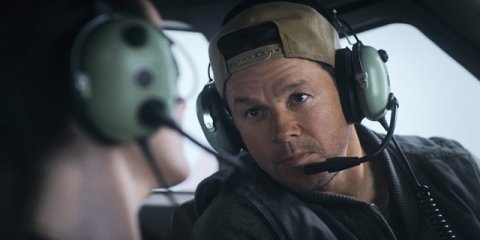
A respite from Winston's non-stop barbs - albeit a temporary one - is provided by the arrival of their pilot, Daryl (Wahlberg), a folksy, eager-to-please veteran who says he's done this run many times before. But soon after takeoff, Winston spots a pilot's license on the floor that will change the course of their flight - and their lives.
For star Mark Wahlberg, he says audiences will go through a range of emotions in this film: "They're going to scream, laugh, cover their eyes, yell at the screen, and cheer. Flight Risk is a wild ride meant to be experienced in theaters."
Dockery says she appreciated being in the tight space while at the same time, "flying through the mountains looking at those incredible views. It was really refreshing - even though we weren't actually 'flying.' Flight Risk is about three characters who can't go anywhere, so there's a kind of intimacy and beauty that will be powerful on the big screen. It will feel vast, and it will feel like they're alone out there."
Producers John Fox and John Davis of Davis Entertainment discovered the spec script by Jared Rosenberg. "We fell in love with the script. It felt very producible, but also very original," says Davis. "John and I started working with the writer and then decided to figure out the best way to move forward." When Mel Gibson's agent reached out, they sent Gibson the script, and he came on board to direct.
For director and producer Mel Gibson, Flight Risk presented challenges and opportunities unlike any he'd tackled before, including the helming of Braveheart, an Academy Award® Best Picture/Director winner; the blockbuster historical drama The Passion of the Christ; and the epic adventure Apocalypto.
"Any time you're in an aircraft, especially one as small as ours, it's going to be claustrophobic," Gibson explains. "We've played into everyone's fear of flying, high altitudes, falling, and crashing."
At the same time, what's happening outside the plane provides its own kind of thrills, as Gibson continues, "The beauty of the film is that it takes place over the beautiful Alaskan Alps, which are stunning and spectacular, as well as intimidating and scary."
Gibson was also drawn to the project because the script "kept me guessing and had some unexpected laughs; it was terrifying and had an intriguing mix of elements I found charming. There are no dead spots."
Bruce Davey, Gibson's longtime producing partner at their company Icon Productions, similarly remembers that the script was "a real page turner, a great dramatic thriller, and it kept me at the edge of my seat."
Screenwriter Jared Rosenberg found inspiration for the script from his great-grandfather, who converted his farm into a small grass airfield. "Growing up, relatives would take us up in these small, single-engine aircraft," he says. "That sense of flight is unlike anything you get on a commercial jet: it is tactile and analog. You feel every bump and air pocket - the rivets rattle - and when you turn, the entire world seems to shift around you. It feels amazing, and unique, and a little dangerous. I was excited by the opportunity to replicate that sensation on the big screen."
Rosenberg adds, "Every movie is tricky to make, but that is especially true of one that requires a deft balance of tension, humor, drama, and action. all while unfolding in more or less real time. To accomplish that feat is a testament to [Mel Gibson's] skill and care as a director." Gibson embraced the challenge, and his longtime producing partner, Davey, notes, "When Mel approaches a script to direct, he does so from inside the story, characters, and production, not from the outside. He puts you inside the action, making you feel that he and you are right there."
Three's a Crowd
To help bring audiences inside the film, Gibson relied on some technical wizardry, but most of all, on the talents of his three cast members. "Michelle, Mark and Topher brought their own bag of tricks," he states. "I took everything they offered and stole it," he adds with a laugh. "I love all the characters and actors, even the really bad guy, and even the ones you only hear offscreen!"
John Davis praises the film's cast, saying, "The cast is absolutely terrific in the movie." Speaking about director Mel Gibson, he adds, "Mel knows how to shoot a movie. He's a talented and seasoned filmmaker. He took what was a confined space and was able to create something both cinematic and visceral, while being hugely entertaining."
"Gibson praises Dockery for her ability to "convey a lot with very little. Michelle is extremely subtle in her expression."
Although a federal U.S. Marshal was made available as a technical consultant for Dockery, the actor says, "I drew more inspiration from law enforcement characters in film and television series I had admired, as well as from the actors who played them. Dockery cites Sarah Lancashire's work as a police sergeant in the British crime drama series "Happy Valley" as particularly inspirational.
"What's really brilliant about those kinds of roles and performances is that they're about the person and character first and law enforcement officer, second," Dockery explains. "Their work doesn't drown out their unique qualities."
To that end, Dockery appreciated that "Madolyn really has heart. There's a past there, and she's trying to rectify a mistake that had turned out horribly. Madolyn is trying to prove she's capable and reliable in the field. I loved that this history and energy are always there."
"So, once things take an unexpected turn," Dockery adds, "Madolyn just wants to get back down on the ground, save Winston, and complete the assignment. It's all about her determination to get him to the trial."
To make that happen, Madolyn must subdue a maniacal killer, take control of the plane, and get it safely down. But she has no piloting experience, and must rely on (among other things) her instincts and training as a marshal.
"I wanted Madolyn to know nothing about the plane's instrument panel," Dockery points out. Instead, she relies on her skills to keep her head in any situation. "As a law enforcement officer, Madolyn is capable of many things," Dockery continues. "That was drilled into me by our technical consultant. Madolyn wouldn't be afraid of violence; in fact, she would always be prepared for it. That was something to really tap into. She's ready for anything."
Before the shocking and deadly threat emerges, Madolyn's chief task is to take control of the smart-alecky accountant/fugitive who's fled to Alaska, wrangle him aboard the small plane, and eventually get him to trial. At first, Winston's constant complaints and off-kilter sense of humor annoy Madolyn, but when their lives are threatened 10,000 feet in the air, amid the ultimate claustrophobic battleground, they form an uneasy alliance.
"By the time Madolyn and Winston board the plane, she's had it with him," says Dockery. "He's been talking nonstop and driving her a bit mad, which provides some comedic moments."
"Topher is wonderful," Dockery continues. "He finds a great balance between humour, fear, and frustration. That contributes to the evolving dynamic with Madolyn. It takes a long time for her to fully trust him."Grace agrees that the fluid give-and-take with Madolyn was a major draw and is tied to Winston's own seismic shifts. "Technically, Winston is a bad guy," he states. "He's a fugitive, but we learn he's not nearly as dangerous as Daryl. And Winston's sarcastic humor is disarming, though it's really masking his fear. By the end, you're rooting for him to survive."
Grace also was pleased with how the film focuses solely on three characters. "You spend a lot of time with Winston, Madolyn, and Daryl," he notes, "and I don't think I've ever played a role where I had the opportunity to do so much in a single film."
"It's a great concept - to be stuck in a small, claustrophobic space, fighting for your life, amid such amazing, cinematic landscapes," Grace adds. "It's a singular idea and I'm so pleased to be a part of it."
That doesn't mean it was a simple process. Far from it. As Grace says, with a laugh: "When I read the script, I thought it was great - and that the film was going to hurt, with the three of us battling in a tiny space. Plus, I was going to be wearing chains for almost the entire shoot. That forces a different kind of performance from you, and it's less acting than usual because it feels like you're really in that situation, in real time."
The third person aboard the troubled flight is the pilot, Daryl, whose easygoing folksy ways seem right for an airman based in the Alaskan wilderness. But Daryl is soon revealed to be a hitman for the mob, assigned to take out Winston and Madolyn, ensuring the former never testifies.
Madolyn subdues the murderous and unhinged Daryl after a brutal exchange that ends with her tasering him. But the mysterious and twisted killer begins to play sinister mind games against her and Winston. He taunts them with an endless stream of unspeakable threats, as well as with as their most hidden secrets.
Mark Wahlberg takes on the role of the psychopath, which is unlike many of his previous roles. "I read the script and fell in love with it," he confirms. "Also, I hadn't played a bad guy in almost 30 years" - since the 1996 thriller Fear, in which his character becomes obsessed with a young woman, played by Reese Witherspoon. "I also fell in love with Daryl, who provides the audience with some . nice surprises."
Wahlberg continues, "Audiences, at first, are going to think, 'Here comes Mark to do something to save the day, but nope. Fifteen minutes into the film, you realise this is not what you thought it was going to be."
A tip-off, perhaps, is Wahlberg's unexpected hairstyle - he's balding - of which the actor is particularly proud. "Yes, I'm bald in this; we chopped off my hair, in the front and back. There's no bald cap or wig. Everything is real there."
This jarring look perfectly embodies Wahlberg's character, Daryl, an unhinged psycho killer. At the start of the movie, Daryl's hair (and identity) is concealed with a hat. But, as the movie progresses, the unsettling truth is revealed and his hat comes off - the bald unhinged pilot is not only not who he says but he is in fact, a hitman.
Wahlberg enjoyed working opposite Dockery and Grace, noting that, "In this confined space, we got to know each other, quickly!"
He similarly embraced the chance to collaborate with Gibson, whose work both in front of and behind the camera, Wahlberg had long admired. "Mel has so much experience as a filmmaker and as an actor," he points out. "Michelle, Topher and I each came in with ideas, and Mel was willing to try anything to service his vision."
Indeed, according to Gibson, Wahlberg "relished this because it was a departure from his usual work, and he was able to explore his darker side, which is, whoa, pretty dark. When I watched some of his improvisations, I wondered, where is this coming from?"
Dockery agrees. "It was necessary for Mark to go far with Daryl's qualities, which are so extreme and almost impossible to grasp. You need to experience what he's capable of. There's also a kind of unnerving playfulness to the way Mark plays it. Daryl is so unpredictable, and just won't give up. Mark relished that, and I understand that it's nice to go to those places, sometimes."
Grace also appreciated Daryl's extreme, next-level viciousness, and the way Wahlberg embodied it. "It was impressive watching Mark, especially during the scenes where Daryl is revealed to be who he really is. Daryl is afraid of nothing, and Mark really went with that. He has an amazing gift to weave his humor and skills together so effortlessly. It's like being in class, being able to watch him do his thing."
The way Daryl gets into their heads is shocking, and perhaps hints at an orchestrated plan. But Wahlberg insists that there's no master scenario in play. "Daryl messes with them psychologically because he's a crazy person! He'll get into their heads any way possible. It was a really fun aspect of the character to play, and audiences will enjoy it."
Daryl's mind games also reveal that there's a leak in The U.S. Air Mashal's Office, which presents another level of danger to Madolyn and Winston. Not only must Madolyn deal with Daryl, who even when tied up presents a formidable threat, she must unravel the mystery of who among her bosses has betrayed her.
Then, there's the matter of flying the plane and taking it in for a safe landing. Madolyn must rely on a voice on the radio transmitter, a pilot named Hassan (Maaz Ali), to guide her through a seemingly impossible task.
Hassan's methods are skillful, yet quite unconventional. His tone is playful, and he even hits on Madolyn, asking her out to dinner as he takes her through the countless steps to getting the plane on the ground. "It was a brilliant notion not to cut away to the character of Hassan, yet still create a strong, fun, and suspenseful dynamic," says Dockery. "The clock is always ticking, and time's running out. Hassan is a lifeline for Madolyn. There's also a frisson going on between them - a flirtation - and it's nice to have those moments of levity in a film this intense. It shows a different side of Madolyn."
Gibson calls the Hassan-Madolyn relationship both "comical and real," adding, "Hassan is an interesting character because he is funny while doing something very serious. He uses psychology brilliantly and is a good guy who's trying to just get these people down safely. Hassan must accomplish a lot just using his voice and wit. He's very serious about helping Madolyn, which is important because you must believe that she can land this plane. It can't just be a technical conversation that has no life; Hassan must keep her calm through joking and being casual with her, and Madolyn finds that reassuring and charming."
Another unseen but important voice on the radio or smartphone is Madolyn's boss and friend, Van Sant (Leah Remini), who has given Madolyn another chance after the tragedy of her last assignment. But during the flight, as Madolyn begins to glean more information about "Daryl" and what he knows about the case, she begins to suspect Van Sant of being tied to the hit on Winston. Madolyn then turns to the director of the marshals, Coleridge (Paul Ben-Victor), for help. But as with everything in Flight Risk, nothing is what it seems.
Tight Space / Epic Scope
While filming aboard a tiny Cessna as it was airborne was impossible, the filmmakers did the next best thing. To provide the stunning visuals of the plane soaring high above the Alaskan wilderness and snow-capped mountains, they used an immersive soundstage known as a Volume, in which LED panels are used as a backdrop for a set on which video or computer-generated imagery can be displayed in real time.
The majority of the film was shot at on a stage in Las Vegas, where the Volume was installed - and so most of the film's action unfolds within the confines of this Cessna Grand Caravan airplane. Set on a 10-foot gimbal, the plane was surrounded by 1,830 LED panels arranged in a 270- degree display capable of playback at 24k horizontal resolution at 24fps.This immersive setup allows audiences to feel as though they are inside of the plane and in the scene with these characters - sharing in their claustrophobia and growing suspicion of one another. Yet, even within the tight space, the plane soars over the vast, breathtaking vistas of the Alaskan Snow Alps. As Gibson puts it, "So, while Flight Risk is set inside a small plane, it feels open, and the vistas are magnificent. The scope is huge."
"The Volume helped to open up our world," says director of photography Johnny Derango. "It emphasises how small our characters and plane are, in context to the magnificent world around them. That was something we focused on: there were times we would go from a super wide exterior shot, and then come in on a tight closeup. I love the juxtaposition of transitioning from the vastness of the world around them to the micro-focused interior and drama."
"Keeping everything grounded and feeling real was important to Mel and myself," Derangocontinues. "We always wanted the audience to feel like they were in that plane with the characters."
Along with visual effects supervisor Michael Ralla, Derango acquired the plates that provided the breathtaking vistas. Ralla then built out a rig with cameras positioned in a flat pinwheel like arrangement. "There were five 8K Red V-Raptor cameras in portrait mode for height, with a 6th facing down. The rig was then hung from a 30' long line on a helicopter flown by world renowned helicopter pilot Fred North, an expert in acquiring aerial images," Derango elaborates. "Fred flew through the mountainous terrain, capturing the visuals that would be played back on The Volume by Lux Machina."
"In a way, we had to make the whole movie before we even started making the movie," Derango summarises.
Gibson adds. "The imagery was so detailed, the plates we shot were amazing, and we projected them onto The Volume wall in incredibly ultra-high definition. It looks totally real." Derango says that while the team worked on The Volume, "the backgrounds interacted flawlessly, the reflections, and the interactive lighting" to mimic real life sky and sun movements above the Alaskan wilderness and snow-capped mountains.
Davey, in turn, reinforces the notion that without this cutting-edge technology, the film would not have been possible. "Imagine if you had to get up in a Cessna [plane], shoot a scene and - take two - you must land, reset, and go up again."
Grace touts The Volume's ability to make everything feel so real to the actors. "My naked eye thought we were flying."
The fourth "star" of Flight Risk is the film's sole set - the plane itself, a Cessna 208B. Production designer David Meyer looks back at the plane's casting: "We wanted the largest bush plane we could find, and the Grand Caravan did the trick. Inside, it's only five and half feet wide, and four and half feet tall, and that presents many challenges, starting with the fact that the actors and crew couldn't stand up in it. Everyone was always in a crouched position. We did some interesing things, like taking the nose cone off where the engine would be, so that the camera could rest on platforms in front of the plane and be close to the actors."
Most of all, Meyer wanted the plane to appear as menacing as possible. "I wanted it to look mean inside," he recounts. "So, we came up with a yellow-ish color, but dulled it down, and aged it out."
Other tricks Meyer employed included foreshortening the wing, to enable an ample distance from The Volume, as well as safety measures, such as the padding, and covering sharp objects with gaskets. Everything in the cockpit was fabricated. "We took apart the original cockpit, because Mel wanted to lower it, to be able to get more of the actors on camera. It was also super-padded, to accommodate the close quarters stunt combat."
Gibson appreciated all the custom modifications necessary to capture the action and drama. "David Meyer understood that the plane had to be modular, that you had to be able to yank the windows out and take the nose off. In short, he had to pull the plane apart and put it back together again. It was a lot of engineering to pull off and was nothing short of miraculous."
The stunts and action aboard the tiny craft provide several of the film's highlights. Dockery credits stunt coordinator David Barrett with taking her through the basics.
Gibson, too, embraced the complexity of staging fights within such a confined space. "We were capturing some pretty brutal exchanges within that small area," he confirms. "That kind of intense action is difficult even with lots of space, but you're working within such a limited area, when you get it, well, it really works."
Adding to the intensity was the plane doing a lot of shaking, rattling, and rolling - befitting a flight in which the pilot is trying to murder his passengers -- all thanks to the gimbal upon which it was mounted. As Grace tells it, "We're all 30 feet up in the air, atop the gimbal, and it felt like we were ascending or diving. Those reactions you see from me on screen are real!"
For the costumes, at least, it was back to basics. According to costume designer Kristen Kopp, the wardrobe was "pulled back quite a bit, to let the story and action speak for itself."
Kopp initially envisioned Daryl as being a kind of "deadhead or parrothead. So, we thought about a tie-dyed shirt or a Hawaiian shirt, as a nod to this goofy but sinister character. But I came to Mel one morning and said, 'I cannot look at a Hawaiian shirt for the entire film.' And he agreed.
"So, I looked at other films that take place in a single space and saw that the costumes were simple and not too colorful. We ended up having Daryl be a kind of working man, whom you wouldn't suspect of being a murderer. He wears a vest on which there's a logo of a plane, which he probably stole from the pilot he murdered and impersonated. Otherwise, he's kind of a blank slate. We didn't want to give too much away about him."
Madolyn is in plain, functional clothes. "Michelle was drawn to that look immediately at the fitting," notes Kopp. "It's the only outfit she tried on. She felt empowered by its silhouette, clean lines, dark colors, and inherent strength."
Dockery adds, "I wanted Madolyn to feel official, but not so much that it looked buttoned-up. She had to be able to move and battle Daryl."
Winston, who's been hiding out in the Alaskan wilderness, wears a simple flannel shirt and hoodie; What else is he going to find out there? "We didn't want him to feel jockey, and we did a Ted Kaczynski type of outfit," Kopp says, referring to the infamous log cabin figure who orchestrated a mail bombing campaign, "and the hoodie came from some images of the real-life white-collar criminal 'Pharma Boy' who was wearing one when he was arrested. Topher took it and ran with it and had a lot of fun with those clothes."
On The Big Screen
Flight Risk, with its relentless pace and action set within a confined space - amid the epic vistas above the Alaska tundra, is unlike any film its principal cast and filmmakers have made before.
Writer Jared Rosenberg says "The movie is, first and foremost, an original, non-stop thrill ride (no IP here!)" And continues "But beyond that, this is a story that takes place in real-time, confining strangers together in a small plane, and so seeing the movie in theaters - with strangers - creates an environment for the audience that mimics the experience of the characters on screen. That's a unique opportunity that elevates the movie-going experience and simply cannot be replicated at home."
Topher Grace confirms that "it's amazing to have a contained thriller that has these incredible panoramic views, and all that's best experienced on the big screen. If you want to feel like you climbed into that plane with us, the big screen is the place to be."
Producer John Davis echoes that "seeing an action movie like this on the big screen is the best way. The sound in the theater, the entire sound system, and the vibrations will create a feeling like nothing else. Having an audience to also watch alongside and experience the film with, that's the moviegoing experience I have always loved."
Mark Wahlberg, in typically unexpurgated fashion, enthuses that the film is, "******* crazy, man, and really cool!" adding, "Audiences can expect the unexpected."
Mel Gibson harkens back to the first time he read the script, and thought, simply "Wow."
"It was terrifying, but I laughed a bunch, was shocked at times, and terrified. I wanted to share with audiences all that I saw in it."
Cast Biographies
Mark Wahlberg (Daryl Booth) is an internationally known actor, producer, and entrepreneur. He has been recognised multiple times for his outstanding work, with two Academy Award® nominations. A native of Dorchester, Massachusetts, Wahlberg has been acting for the past 30 years, appearing in more than 50 films.
His breakout role in Boogie Nights, for director Paul Thomas Anderson, established Wahlberg as one of Hollywood's most sought-after talents. Highlights of his remarkable film career include The Departed, The Fighter, Lone Survivor, Shooter, Ted, and Invincible.
As a successful film and television producer, his credits include Entourage, Boardwalk Empire, Father Stu, Patriots Day, and Wahl Street.
Wahlberg is also a passionate entrepreneur, having co-founded Municipal sports utility gear and Wahlburgers, and partnering with Flecha Azul Tequila and the Hallow app, among others.
The Mark Wahlberg Youth Foundation was created in 2001 to benefit inner-city children and teens.
Michelle Dockery (U.S. Deputy Marshal Madolyn Harris) is best known for her leading role as Lady Mary Crawley in ITV's Downton Abbey, multiple Primetime Emmy® and Golden Globe® award nominee Michelle Dockery's ability to inhabit diverse characters with depth and authenticity has made her a sought-after talent both onscreen and onstage.
2024 marks an exciting filmic year for Michelle, who will be seen in numerous starring roles including the highly anticipated Here. Described as a "breathtaking and revolutionary odyssey through time and memory," Here follows the events of a single room and its inhabitants spanning from the past into the future. Directed by Robert Zemeckis, the film reunites Tom Hanks, Robin Wright, and writer Eric Roth for the first time since their collaboration on the multi- Academy Award®-winning Forrest Gump.
Also on the slate is Destry Allyn Spielberg's debut Please Don't Feed the Children, a psychological thriller that follows a gang of orphans who travel to the South in search of a new life after a viral outbreak decimates the adult population of the nation, only to find themselves at the mercy of a psychotic woman (Dockery) who is hiding a perilous secret.
Earlier this year, Michelle was seen starring in Moritz Mohr's Boy Kills World, which premiered at the Toronto International Film Festival in September 2023. The dystopian revenge thriller follows Boy, who is deaf and non-verbal, as he's trained in the jungle by a mysterious martial art master to take down the nefarious Van der Koy family clan. Michelle stars as Melanie Van der Koy, a satirical powerhouse and sociopath who tried to project a powerful cohesive family image to hide the desperation behind their decaying dynasty.
On the small screen, Michelle recently starred in the highly anticipated BBC series This Town, a six-part series created by Steven Knight (Peaky Blinders) which follows the story of a family band's formation during the emergence of ska music in Britain in the 1980s. Set during the first Thatcher ministry, and against a backdrop of racial tensions and violence which saw riots rage throughout the UK, This Town tells the story of a group of young people fighting to choose their own paths in life, each in the need of the second chance that music offers.
In 2022, Michelle appeared in Netflix's hugely popular TV miniseries Anatomy of a Scandal as Kate Woodcroft, a fiercely determined prosecutor. In 2019, Michelle returned to her to her much-loved role of Lady Mary Crawley in Downton Abbey, the film adaptation of the series directed by Michael Engler. She also reprised the role in 2022 for Simon Curtis's sequel film Downton Abbey: A New Era, and much to the delight of long-standing supporters, Michelle is set to reprise her role as Lady Mary for a third Downton Abbey film expected in 2025. Later in 2019, Michelle appeared in Guy Ritchie's The Gentleman as Rosalind Pearson, the wife of a notorious drug baron, a film which generated huge box-office success. In 2018, Michelle received the inaugural Variety Icon Award for CannesSeries, which recognises outstanding achievement in acting that has been praised by both fans and critics.
Throughout her career, Michelle has transitioned seamlessly between stage and screen. Her most recent appearance on stage was between 2017-2018 as Diana Christensen in Network at The National Theatre, where she starred alongside Bryan Cranston. The play was nominated for a Laurence Oliver Award for Best New Play in 2018. Michelle's significant impact on the stage has also been seen in her performances as Maroussia in Burnt by the Sun at The National Theatre in 2009, for which she was nominated for a Laurence Olivier Award for Best Actress in a Supporting Role, and Eliza Doolittle in the Old Vic's Pygmalion in 2008. Michelle's other theatre credits include: The Crucible's Hamlet (2010), The Almeida's Dying for It (2007), The National Theatre's Pillars of the Community (2005), Henry IV Parts 1 and 2 (2005), and His Dark Materials (2004). Michelle is also a trained singer, and released her first EP, The Watching Silence, together with Downton Abbey co-star Michael C. Fox, as the duo "Michael and Michelle". Earlier this year, the duo wrapped up their UK tour, which ended in February 2024.
In 2017, Michelle starred as Alice Fletcher in Netflix's series Godless, which follows the story of a ruthless outlaw who leads a frenzied hunt for an ex-gang member. For this role she was nominated for a Critic's Pick Award in 2017, as well as a Primetime Emmy® Award in 2018. During 2016 and 2017, Michelle took on the lead role of thief and con-artist Letty Raines for two seasons of Good Behavior, based on the novel of the same name written by Blake Crouch. Between 2010-2015, Michelle first appeared in her onscreen breakout role as the iconic Lady Mary Crawley in ITV's Drama series Downton Abbey. During this time, Michelle was nominated for three consecutive Primetime Emmy® awards and a Golden Globe®, and received multiple other accolades, including winning numerous ensemble Screen Actors Guild awards.
Michelle's other screen credits include: the animated series Amphibia (2020-2022), Defending Jacob (2020), The Sense of an Ending (2017), Self/less (2015), Edward Hall's Restless (2012), Joe Wright's Anna Karenina (2012, with Keira Knightley and Jude Law), Hanna (2011, with Saoirse Ronan and Cate Blanchett), The Courageous Heart of Irena Sendler (2009), and Benjamin Ross's Poppy Shakespeare (2008).
Michelle has been working with Smart Works for a number of years, a charity that helps women find secure employment through training, coaching and confidence building. In 2014, she was also announced as Oxfam's first Humanitarian Ambassador.
Topher Grace (Winston) recently wrapped his pivotal role in John Patton Ford's A24 film Huntington alongside Glen Powell. Topher also recently wrapped Scott Beck and Bryan Woods's Heretic, where he co-starred opposite Hugh Grant (for A24).
On TV, Topher was last seen in ABC'S Home Economics, which he executive produced. He has also starred in the Focus feature Irresistible opposite Steve Carrell for director by Jon Stewart. Back on the small screen, he starred in the season 5 Smithereens episode of Black Mirror for Netflix. Prior to that, Topher appeared opposite Brad Pitt in the Netflix feature War Machine for director David Michod, and in the Spike Lee film BlacKkKlansman, where he played white supremacist David Duke. Other recent feature credits include Under the Silver Lake, where he co-starred opposite Andrew Garfield; Truth, with Cate Blanchett and Robert Redford; and the Lionsgate film American Ultra opposite Jesse Eisenberg and Kristen Stewart.