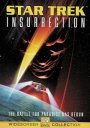
DVD
DVD The Prime Directive requires Starfleet not to interfere with the natural development of other civilisations. When Picard is confronted with orders that undermine those principles, he and the crew of the Enterprise are forced to lead an insurrection to preserve a paradise planet.

Details
Whilst Captain Picard and the Enterprise crew are occupied with a particularly tedious diplomatic function, Data is taking part in a covert Federation observation mission on the Ba'ku homeworld. However, something goes seriously wrong when the android apparently malfunctions, attacks members of the observation team and exposes their hidden presence to the planet's inhabitants.
With Starfleet preparing to destroy Data before he can cause further damage, Picard diverts the Enterprise to the planet and personally intervenes. After successfully recovering his officer, he begins investigating what caused Data's unusual behaviour and rapidly discovers that Starfleet hasn't been entirely honest about its activities.
The peaceful Ba'ku appear to be a relatively primitive agricultural society, having deliberately rejected much of their advanced technology in favour of a simpler existence in harmony with their surroundings. However, their planet possesses something considerably more valuable than initially meets the eye.
The unusual metaphasic radiation surrounding the planet has remarkable regenerative properties, slowing the ageing process and even reversing some of the effects of injury. Unsurprisingly, Starfleet and their Son'a allies are extremely interested in exploiting it.
Unfortunately, harvesting the radiation requires the six hundred Ba'ku inhabitants to be removed from their home. Admiral Dougherty and Son'a leader Ru'afo therefore intend to secretly relocate the entire population to another planet, leaving them free to exploit the radiation without the Ba'ku ever knowing what happened.
Picard is appalled. Whatever benefits the radiation might provide to the Federation, forcibly removing an entire population from its home is something he refuses to accept. With Starfleet apparently prepared to abandon its own principles, Picard removes his uniform and prepares to defend the Ba'ku himself.
He doesn't remain alone for long. The Enterprise crew choose to stand alongside their Captain, with Picard and several officers remaining on the planet to protect the Ba'ku whilst Riker and Geordi attempt to take the Enterprise out of the system and inform the Federation Council about what is really happening.
Picture & Sound
The picture is excellent and really helps bring the colourful Ba'ku environment to life. With such a bright, detailed image, the lush and mountainous areas of California where the village scenes were filmed look stupendous, whilst the specially constructed Ba'ku village is so convincing you could almost move in.
Colours are particularly rich and vibrant throughout, with the countryside, blue skies and planet's rings providing a considerable contrast to the darker starship interiors normally associated with Star Trek. Detail is equally impressive and the transfer is relatively clean, with no significant problems from dust, damage or compression artifacts.
The CGI effects are generally impressive too, particularly the gas clouds and colourful rings surrounding the planet. However, the clarity of the transfer is occasionally a mixed blessing. Some of the less convincing effects, especially the small pet belonging to one of the Ba'ku children, are painfully obvious. Rather than hiding weaknesses in the original effects, the DVD occasionally exposes them.
Unfortunately, with the Region 2 edition containing numerous subtitle and alternative-language tracks, the DTS soundtrack available on the Region 1 Special Edition has been dropped. That's a shame, particularly on a release that otherwise makes such a good attempt at providing the definitive version of the film.
Still, the 448Kbps Dolby Digital 5.1 soundtrack is superb. There's plenty of ambient activity aboard both the Enterprise and on the planet's surface, whilst the various space sequences make excellent use of the surround channels as shuttles and other craft whizz around the soundstage.
Jerry Goldsmith's impressive score adds considerably to the atmosphere and tension, dialogue remains crisp and clear in the centre channel and there's some good use of the LFE channel during the more dramatic battle sequences. All in all, just what a Star Trek film demands.
Menu & Extras
The menu systems across both discs are scored and nicely animated, using what appears to be the bridge and various schematics from Ru'afo's craft and the collector. Selecting a sub-menu produces a nice transition as the bridge scrolls around before revealing another control panel. The extras menus can look a little cluttered at times, but navigating the numerous options shouldn't cause any problems.
If there's one film series that can hold its head up high and genuinely justify the Special Edition tag, then Paramount's continuing collection of Star Trek Special Editions certainly can. I'll start by complaining that this is the DVD release we should have received in the first place, but the whopping three hours of additional material at least gives owners of the original disc a genuine reason to consider upgrading.
With director Jonathan Frakes coming across so well in the various documentaries on the supplemental disc, it's a great shame he wasn't able to stretch to providing an audio commentary for the film. Although the disc is packed with numerous subtitle tracks, it's hardly a long movie and I'm sure one could have been accommodated.
Nevertheless, the first disc isn't completely barren. Star Trek trivia gurus Michael and Denise Okuda provide a textual commentary throughout the entire film. The casual viewer may find little of interest, but Trekkies should love the numerous nuggets of information, including details of sets and props reused from previous Star Trek films and television series. For something as simple as a textual commentary, it's surprisingly addictive.
But it's the second supplemental disc where the real treasure is to be found, and boy, is there a massive collection to work your way through. The material is split into six sections: Production, The Star Trek Universe, Creating the Illusion, Deleted Scenes, Archives and Advertising.
Better still, unlike many DVD releases that attempt to bolster their extras list with dozens of inadequate two-minute featurettes, most of the material here is substantial. Many of the documentaries run between ten and twenty minutes and each is accompanied by multiple subtitle tracks.
The Production section contains a comprehensive collection covering the sets, stunt work, story and Jonathan Frakes' experience directing the film. There's inevitably a little repetition between interviews, but it's generally limited to a few seconds and hardly becomes irritating.
The seventeen-minute It Takes a Village looks at the creation of the enormous Ba'ku village set. Production designer Herman Zimmerman and various cast members discuss the process of designing and constructing what was apparently the largest Star Trek set ever built, high above Lake Sherwood in the California mountains.
Next is the twenty-minute Location, Location, Location, where Jonathan Frakes - who gets particularly excited about the sets, stunt work and location - Patrick Stewart, Donna Murphy and the rest of the Trek clan discuss the pleasures and difficulties of working outside rather than being permanently cooped up on a studio lot. There's plenty of behind-the-scenes footage and Frakes' sheer enthusiasm makes it all the more enjoyable.
The fifteen-minute The Art of Insurrection sees illustrator John Eaves discussing the impressive artwork, props and designs required for the film's new CGI spacecraft. Seeing the original concepts alongside the completed effects sequences makes this exactly the sort of featurette I enjoy, and it must have been extremely rewarding for the design team to see their ideas eventually appear on the big screen.
The six-minute Anatomy of a Stunt examines a sequence involving Data and the Son'a that was ultimately deleted from the film. The stunt itself isn't particularly fascinating, but there's plenty of behind-the-scenes footage and interviews with the stunt coordinator and the blokes preparing to throw themselves off the side of a cliff.
The seventeen-minute The Story contains an interview with writer Michael Piller discussing the development of the screenplay. Accompanied by production stills and clips from the film, it's an interesting look at the questions and moral issues raised by the story and provides considerably more insight than the usual promotional fluff.
The twenty-five-minute Making Star Trek: Insurrection contains studio interviews with the cast alongside on-set interviews and plenty of behind-the-scenes footage. Some information inevitably crops up elsewhere on the disc, but overall it's an interesting peek at the production and demonstrates just how close the principal actors had become after so many years working together.
Finally, this mammoth section is rounded off with the nineteen-minute Director's Notebook. Once again there's oodles of behind-the-scenes footage and Frakes saying "Action!" a lot. Interestingly, Frakes readily admits that the story wasn't as strong as First Contact, although he believes Insurrection looked considerably better. His comments initially seem a little odd coming from the director, but his honesty is refreshing and his enthusiasm for the project is absolute.
The Star Trek Universe section contains two featurettes: the seventeen-minute Westmore's Aliens and thirteen-minute Star Trek's Beautiful Alien Women. The first contains an interview with prolific make-up designer and supervisor Michael Westmore, accompanied by plenty of clips of his creations from across the various Star Trek series.
The second is a rather fun collection of interviews and clips involving the various female aliens and the men who encountered them. Jonathan Frakes gets all hot and sweaty reminiscing about his "prosthetic head in every port", whilst Robert Picardo is equally amusing recalling the Doctor's various female encounters, especially Seven of Nine. It's all tongue-in-cheek stuff, but it's also very funny.
The Creating the Illusion section examines three sequences - Shuttle Chase, The Drone and Duck Blind. Running for around fifteen minutes in total, they're not quite as interesting as the other documentaries, possibly because of the rather wooden narration from co-producer and second-unit director Peter Lauritson. Still, there's plenty of storyboards, pre- and post-production CGI footage and a good level of technical detail.
Next are seven Deleted Scenes, including an alternative ending. Fortunately there's a Play All option and most of the cuts are relatively minor extensions to existing scenes. Rather than leaving you to work out the context for yourself, Peter Lauritson also introduces several of them and explains where they originally fitted into the film.
The Archives section consists of approximately sixty storyboard images and a similarly sized photograph gallery. Finally, the Advertising section contains the teaser and theatrical trailers, the original promotional featurette and a trailer for something called Borg Invasion, which I have absolutely no idea what it is.
All in all, this is one of the most comprehensive collections of extras you're ever likely to get for a film. It's just a pity that much of this material clearly existed when Paramount released the original DVD and wasn't made available at the time.
Overall
It's a common trait of the Star Trek movie franchise that the odd-numbered films tend to suffer in the story and action stakes. However, whilst it may not be as exciting as some of the other outings, Insurrection breaks the mould with a particularly good script, even if there isn't a huge amount of action either in space or on the planet's surface.
That said, First Contact takes some beating! Watching Insurrection again for this Special Edition release, I'd probably stop short of putting it above the Borg's previous outing, but it remains a considerably better film than its reputation might suggest.
The film works best when it's concentrating on Picard's moral dilemma. Starfleet has decided that relocating six hundred people is acceptable because the regenerative properties of the planet could potentially benefit billions. Picard's argument is that principles such as the Prime Directive don't mean very much if you simply ignore them whenever breaking them becomes convenient.
The story also seems to give a subtle nod towards both recent and more distant history, particularly the ethnic cleansing witnessed in the Balkans and the forced relocation of populations under Nazi Germany. It's fairly serious material for what is otherwise a relatively lightweight Star Trek adventure.
Fortunately, the film isn't always so serious and the crew of the Enterprise still find plenty of time to raise a few laughs as the radiation begins having an effect. Geordi's sight returns, Riker and Troi rediscover their attraction to each other and Worf finds himself suffering the Klingon equivalent of puberty.
There are also a few oddities that made me ponder things, although I guess that's just me being cynical and picky. If the life-giving properties of the planet can cause Geordi's sight to return, and Federation technology can propel mankind across the galaxy at several times the speed of light, why the hell hasn't anyone managed to find a cure for male baldness? More importantly, why didn't the planet's radiation make Picard's hair start growing back?
Perhaps even metaphasic radiation knows when it's beaten.
And don't get me started on that Manual Steering Joystick and the "Riker Manoeuvre". Okay, so it may be intended as a bit of an in-joke, but watching that joystick rise majestically out of the Enterprise-E's control panel still had me slapping my forehead in despair.
Thankfully, those moments don't spoil what remains a thoroughly enjoyable film. Patrick Stewart is as dependable as ever, the regular cast have an easy chemistry after so many years together and Jonathan Frakes keeps everything moving at a reasonable pace even when the story deliberately slows down to spend time with the Ba'ku.
What really changes the equation this time around, though, is the DVD itself. The original release was a major disappointment: an excellent film and transfer accompanied by static menus and a miserly collection of supplementary material. This Special Edition finally gives the film the DVD presentation it deserved.
The difference is enormous. Nicely animated menus, a fascinating Okuda text commentary, substantial production documentaries, deleted scenes, storyboards, galleries and approximately three hours of supplementary material turn what was previously a rather ordinary DVD into a genuinely impressive package.
I'd still have liked a Jonathan Frakes audio commentary and it's unfortunate that Region 2 loses the DTS soundtrack available to American buyers, but those are relatively minor complaints when weighed against everything Paramount has included.
There's also a slightly irritating question hanging over the whole package: why wasn't this material included in the first place? Many of us already bought Insurrection on DVD once, and Paramount are effectively asking us to pay again for the version they should arguably have released several years ago.
Fortunately, unlike some so-called Special Editions, there's enough additional material here to make the upgrade worthwhile. This isn't simply a new box, a couple of trailers and an extra interview dressed up as a premium release. There's a genuinely substantial second disc to explore.
Science-fiction fans, and particularly Trekkies, should therefore find this a very tempting purchase. The asking price for Paramount's two-disc sets remains rather excessive, but hunt around on the Internet and you'll undoubtedly find it considerably cheaper.
Insurrection may still sit in the shadow of First Contact, but it's an underrated entry in the series and this Special Edition finally gives it the DVD release it deserved. If you already own the original disc there's enough here to justify an upgrade; if you don't, there's absolutely no reason to buy the earlier version now.
Special features
Disc One
- Text Commentary by Michael and Denise Okuda
Disc Two
- Production - It Takes a Village; Location, Location, Location; The Art of Insurrection; Anatomy of a Stunt
- The Story
- Making Star Trek: Insurrection
- Director's Notebook
- Creating the Illusion - Shuttle Chase; The Drone; Duck Blind
- The Star Trek Universe - Westmore's Aliens
- Star Trek's Beautiful Alien Women
- Deleted Scenes including Alternate Ending
- Archives - Storyboards; Photo Gallery
- Advertising - Teaser Trailer; Theatrical Trailer; Borg Invasion Trailer
- Original Promotional Featurette