 4K UHD
 On the hottest day of the year, unemployed defence worker William Foster abandons his car in a gridlocked Los Angeles traffic jam and sets off across the city on foot, determined to reach his estranged daughter on her birthday.

Details
It's another sweltering day in Los Angeles and, like thousands of other commuters, William Foster (Michael Douglas) finds himself trapped in a seemingly endless traffic jam. Sitting in the same gridlock is Sergeant Prendergast (Robert Duvall), an experienced police detective approaching his final day on the job before taking early retirement. These days Prendergast spends considerably more time behind a desk than out on the streets, partly to satisfy his increasingly anxious wife Amanda (Tuesday Weld), who can't wait for him to leave the police force altogether. What neither man realises is that before the day is over their paths will cross in considerably more dramatic circumstances.
With the temperature rising, his car air-conditioning broken and the noise and frustration of the city closing in around him, Foster's patience is already being pushed to its limit. Then a fly starts buzzing around the car and, despite his increasingly irritated attempts to swat it, simply refuses to go away. It's seemingly the final straw. Foster gets out, abandons his car in the middle of the road and, briefcase in hand, announces that he's "going home" before setting off across Los Angeles on foot.
Setting off across Los Angeles on foot probably isn't the wisest decision Foster could make. This is a city where almost everybody seems to travel by car and, judging by some of the neighbourhoods his journey is about to take him through, walking with a briefcase in his hand isn't exactly without its risks. But Foster has finally reached the point where he simply doesn't care and nothing - or anybody - is going to get in his way.
It doesn't take long for that determination to cause problems. An argument over the price of a can of Coke at a convenience store is followed by encounters with a pair of gang members, a fast-food restaurant with a particularly inflexible breakfast policy and a decidedly unpleasant army surplus store owner. With Foster's patience with the world apparently exhausted, each encounter becomes rather more confrontational than the last.
Yet amongst the increasingly violent encounters there are occasional reminders of what Foster believes he's making the journey towards. He stops to buy his daughter a birthday present, choosing a brightly coloured unicorn snow globe which seems strangely out of place amongst the heat, anger and chaos surrounding him. Whatever else may be happening, Foster remains determined to reach his daughter.
Meanwhile, Prendergast begins to realise that a series of apparently unrelated incidents across the city may all involve the same man. Witness reports repeatedly describe a middle-aged man wearing a white shirt and tie and carrying a briefcase - an appearance which makes Foster stand out like a sore thumb in some of the neighbourhoods he's travelling through. Despite supposedly being on the verge of retirement and spending most of his time behind a desk, Prendergast's old instincts quickly return. With Foster continuing towards his destination and becoming increasingly unpredictable along the way, he sets about discovering who he is, where he's going and, perhaps most importantly, what he intends to do when he gets there.
Picture & Sound
It's fair to say that Falling Down has come a long way since I reviewed Warner's original UK DVD for DVD365.net back in 2000. Back then I described the picture as little more than a modest improvement over VHS. A Blu-ray release followed several years later, but Arrow has now gone back to the original 35mm negative for a brand new 4K restoration, with the colour grading supervised and approved by cinematographer Andrzej Bartkowiak.
The Los Angeles exteriors provide some of the most immediately impressive moments of the new presentation. HDR gives the bright sunshine, colourful signs, shops and buildings plenty of life, although contrast is quite high and the skies aren't always the perfectly blue expanses you might expect (although I'm sure the notorious LA smog probably sees to that). What really impresses, though, are the warm colours of the morning rush hour. Combined with the increasingly uncomfortable commuters trapped in their cars, you can almost feel the stifling Los Angeles heat without actually having to endure an LA rush hour yourself.
Perhaps surprisingly, grain isn't anywhere near as prominent as I was expecting. There's still a hint of natural grain visible, as there should be, but for the most part this is a remarkably clean presentation. Better still, there are no obvious blemishes or imperfections to distract from the image, yet the restoration doesn't appear to have achieved that cleanliness by simply scrubbing away the finer detail.
And there's certainly plenty of detail to appreciate, something that's apparent from the opening traffic jam. Close-ups of Foster reveal individual beads of sweat running down his face, while the increased resolution brings impressive definition to faces, clothing and the numerous little details crammed into the frame. More importantly, that clarity helps reinforce just how unpleasantly hot and uncomfortable everybody looks - particularly Foster - before he finally abandons his car.
That clarity extends well beyond faces and clothing. The murals across the walls of Los Angeles are bright and colourful, while even the individual adverts plastered across a telephone box can be easily picked out. I was tempted to call a few numbers, but was put off by the international call charges. There's plenty to explore within the frame without the image ever appearing artificially sharpened simply to show off the additional resolution.
Black levels are also pleasingly solid throughout. Both the bright exterior sequences and darker interiors retain strong blacks without appearing washed out, while detail remains visible within the darker areas of the image. Combined with the excellent clarity, it makes for a consistently impressive presentation of a film now more than thirty years old.
Arrow provides two newly restored audio options: the original 2.0 stereo track and a DTS-HD Master Audio 4.0 surround presentation. For the purposes of this review I opted for the latter and, while it's certainly an improvement on the original stereo track, it's not without its shortcomings.
Dialogue could certainly do with a little more presence, particularly when things get busy. The ambient effects and James Newton Howard's musical score are both willing and able to dominate the soundstage, occasionally leaving the dialogue fighting rather harder for attention than it really should.
Fortunately, the additional channels aren't going to waste. The surrounds are put to particularly good use in creating the noise and bustle of Los Angeles, with traffic and police sirens spreading around the soundstage while helicopters clatter overhead and move convincingly around the listening position. Given how important the city itself is to the film, that additional sense of space makes a considerable difference.
So, while the 4.0 presentation could have benefited from a better balance between dialogue and everything happening around it, there's no question that it provides a more immersive experience than the original stereo track. Purists also have the benefit of that newly restored 2.0 option, so it's good to see Arrow providing both rather than replacing the original mix altogether.
Menu & Extras
Anyone who remembers Warner's original DVD release will already know that we don't have a particularly difficult target to beat when it comes to supplementary material. That release contained precisely nothing, so Arrow's 4K edition represents a considerable improvement before we've even pressed play.
The real highlight for me is Man on the Edge, a new interview with screenwriter Ebbe Roe Smith which runs for around nineteen minutes and proves absolutely fascinating. Smith discusses the origins of the screenplay, his own move from acting into writing and the difficulties involved in getting Falling Down made, while also revealing how some of the individual encounters Foster experiences during his journey came about.
Particularly interesting is Smith's discussion of how Foster developed from the character he originally wrote into the man we eventually see Michael Douglas playing on screen. There are also some fascinating details about scenes which were changed or removed altogether and the real-life inspirations behind others. It's exactly the sort of supplementary feature I enjoy, actually adding something to our understanding of the film rather than simply telling us how wonderful everybody was to work with. And, just to prove Smith wasn't content with remaining behind the typewriter, look closely at the frustrated motorist immediately behind Foster when he abandons his car at the beginning of the film - that's Smith himself.
Going Home is another particularly interesting addition, retracing Foster's journey through Los Angeles and revisiting many of the locations used in the film. More than thirty years later, quite a lot has changed and it's rather surprising to discover just how many of the original locations have either disappeared completely or been replaced by parks and other developments, while other areas have become considerably more upmarket.
It's also interesting to see how Foster's supposed journey compares with the actual geography of Los Angeles. I was half expecting the locations to form a reasonably convincing route across the city, but inevitably that's not always the case. Locations which appear to be the next stop along Foster's walk can actually be some distance apart - but then that's filmmakers for you. What matters is that on screen we never question it.
The archive interview with Michael Douglas, Deconstructing D-Fens, is another worthwhile inclusion and works particularly well alongside Ebbe Roe Smith's interview. Douglas' interpretation of Foster largely reinforces Smith's original vision of the character - this isn't simply an ordinary man who suddenly snaps because he's stuck in traffic, but somebody carrying around a considerable amount of resentment long before we meet him.
Douglas also touches upon Foster's background in the defence industry and the changing America in which he finds himself. Having spent years working in an industry which was only too happy to employ him while the Cold War continued, the collapse of the Soviet Union helped make people like Foster expendable. It's another important piece of the character: rightly or wrongly, Foster believes he's done what his country and society expected of him, only to find that the world has changed and no longer appears to have much use for him. Coming after Smith's recollections, it's particularly interesting to hear Douglas reaching many of the same conclusions about Foster from the other side of the camera.
The archival audio commentary is something of an unusual affair, bringing together director Joel Schumacher, screenwriter Ebbe Roe Smith, editor Paul Hirsch, LA Times writer Shawn Hubler and several members of the cast, including Michael Douglas. Rather than everybody sitting down together to watch the film, their separately recorded contributions have been edited into a feature-length track.
As a result, it's not always the most conventional or scene-specific commentary, and inevitably there's some overlap with the other material on the disc, particularly Ebbe Roe Smith's excellent new interview. Nevertheless, there's plenty of worthwhile discussion about Foster, the screenplay, the changing face of America and the filmmakers' intentions. I'm generally rather hit-and-miss when it comes to audio commentaries, but there's enough substance here to make this one worth dipping into.
James Newton Howard gets his own nine-minute interview in At War with the World, discussing his previous collaboration with Joel Schumacher on Flatliners and how he subsequently became involved with Falling Down. Those with a particular interest in film scores will undoubtedly get more from it than I did, but it's another worthwhile contribution to the package.
Rounding off an already impressive selection of on-disc extras are the original trailer and an image gallery.
The Limited Edition also includes a nicely produced collector's booklet containing two new essays. Alexandra Heller-Nicholas examines Falling Down against the political and social climate surrounding the film, including its connections with the defence industry and the changing America in which Foster finds himself. It's particularly relevant given how much of the film still resonates more than thirty years later.
Simon Ward takes a rather different approach, concentrating on the instantly recognisable appearance of D-Fens - crew cut, glasses, white short-sleeved shirt and tie - and considering similar characters and imagery elsewhere in cinema. Given that Foster's appearance has become arguably one of Michael Douglas' most iconic looks, it's an interesting subject in its own right and complements the film rather nicely. My only complaint is that the booklet is small in size, thus the typeface is on the small side. Some glasses (preferably not D-Fens') might be called for.
Overall
More than thirty years after its original release, Falling Down remains a fascinating and frequently uncomfortable film, not least because it repeatedly tempts us into agreeing with William Foster before giving us increasingly good reasons to question whether we should.
Perhaps what's most surprising is just how relevant Falling Down remains today. The cars, clothes and lack of mobile phones may firmly place it in the early 1990s, but many of the things irritating Foster haven't changed very much at all. Traffic jams, rising prices, poor service, bureaucracy and products which bear only a passing resemblance to the advertisements selling them are every bit as capable of winding us up today. In that respect, perhaps the film isn't merely relevant - it may actually be timeless.
That's also what makes Foster such an uncomfortable character to follow. There are moments when you find yourself thinking that he actually has a point, only for his reaction to remind you that recognising the problem and dealing with it appropriately are two very different things.
Then, of course, there's Whammyburger, arguably the film's most iconic sequence. Foster arrives moments after the restaurant has stopped serving breakfast and simply cannot understand why somebody can't make him what he wants. What begins as a familiar irritation gradually becomes considerably more uncomfortable as his frustration escalates and everybody around him realises this isn't simply an unhappy customer.
Yet perhaps the funniest moment comes when he finally orders lunch and compares the limp, rather sorry-looking burger he's been handed with the enormous, perfectly presented version displayed above the counter. It's a moment I still think about whenever I visit one of the well-known burger chains and discover that what has emerged from the wrapper bears only a passing resemblance to the colourful photograph on the menu. On that particular point at least, Foster may have a case. His approach to complaining about it, however, probably isn't one I'd recommend.
One little moment I've always liked comes when Foster stops to buy his daughter a present and chooses a unicorn snow globe. It's such a bright, colourful and innocent little object to be carrying around in the middle of everything that's happening. For a moment we're reminded that, in Foster's mind at least, he's still a father making his way towards his daughter on her birthday, even if the reality of his family situation is considerably more complicated.
Even Foster's repeated insistence that he's "going home" becomes more complicated as we learn more about him. Home isn't actually where Foster lives; it's where his ex-wife Beth and daughter Adele live, and somewhere he no longer belongs. We never really need to know where Foster's own home is because that's not the home he's trying to reach. He's attempting to return to the family, the house and ultimately the life he believes he should still have, but the further he travels, the clearer it becomes that reaching his destination isn't going to restore any of it.
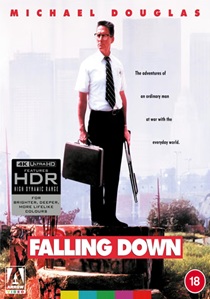
Michael Douglas gives one of his most memorable performances as Foster, complete with what has arguably become one of his most iconic looks. The white shirt and tie, glasses and briefcase are so immediately associated with Falling Down that Arrow hasn't even needed to produce the usual newly commissioned artwork which accompanies many of its releases - that image of Douglas as Foster is more than capable of selling the film on its own. He initially looks like an ordinary office worker having an exceptionally bad day, but as his journey continues and that once-neat appearance begins to deteriorate, our understanding of the man wearing it gradually changes too.
Robert Duvall's Prendergast provides an important counterpoint to Foster. In many respects the two men aren't as different as they first appear. Both are middle-aged, frustrated with the direction their lives have taken and dealing with difficult personal circumstances. Prendergast has retreated to the relative safety of a desk job, partly because of his wife Amanda's fears following the loss of their daughter, and is preparing to retire from a career he clearly isn't ready to leave behind. Foster, meanwhile, is desperately trying to reclaim a family life which has already disappeared. One man spends the day trying to return to something he no longer has, while the other gradually realises he may not be ready to give up what he still does.
Los Angeles itself is every bit as important. Joel Schumacher and cinematographer Andrzej Bartkowiak make the city feel oppressively hot, noisy and confrontational from the moment we enter that opening traffic jam. Foster doesn't simply travel across Los Angeles; the city seems to throw one irritation after another directly into his path, almost daring him to react.
Of course, the further Foster travels, the more difficult it becomes to maintain the idea that we're simply watching an ordinary man having a particularly bad day. His problems didn't begin in that traffic jam. The anger, his failed marriage and his inability to accept that the life he once had is over were already there; the events of the day simply give them somewhere to go.
There's also a growing sense that Foster feels betrayed by the country and the system he believed he was serving. He worked in the defence industry during the Cold War, doing a job which was apparently important while the Soviet Union remained a threat, only to find himself surplus to requirements once that world changed. In Foster's mind, he worked, contributed and played by the rules, yet still ended up unemployed and separated from his family. It doesn't excuse anything he does, but it helps explain why so much of his anger seems directed at a society he believes has broken its side of the bargain.
Beth (Barbara Hershey) is particularly important in changing our perception of Foster. Until we begin to understand their history, we've largely experienced the day from his point of view and it's easy to imagine a man simply desperate to see his daughter on her birthday. Beth sees something very different. Her reaction to the prospect of Foster arriving isn't irritation or resentment but genuine fear, gradually revealing that the harmless family man Foster still appears to see when he looks at himself isn't necessarily the man experienced by those closest to him.
As for Arrow's 4K release, there's very little to complain about. The new restoration does the film justice, the 4.0 soundtrack provides a welcome improvement over the original stereo mix, the excellent supplementary material adds genuine value and the packaging makes this feel like a release put together with some real care. I do miss the wonderfully chunky box sets Arrow has produced for some of its cult titles - a category in which Falling Down surely belongs - but that's hardly enough to detract from what is an excellent package.
I've known Arrow Films since their early days, when some decidedly obscure titles would arrive at DVD365.net towers for review, and it's been remarkable watching them go from strength to strength and build the catalogue they have today. I'm actually rather surprised Warner didn't choose to produce its own special edition of Falling Down, but perhaps we should be thankful they didn't. Arrow has been given the opportunity instead and, quite simply, this release is a corker.
And then comes perhaps the most important line in the entire film: "I'm the bad guy?" Foster seems genuinely surprised by the realisation. He's spent the day seeing himself as the victim - the man ripped off by shopkeepers, threatened by gang members, frustrated by corporations, discarded by his employer and prevented from returning to the family he still regards as his own. In his mind, he worked hard, served his country in his own way and played by the rules, only for the rules to change around him. Everybody else has been breaking the bargain while he's simply been pointing it out.
Which leaves an uncomfortable question. Has Los Angeles brought out the criminal in Foster, or has Foster's journey simply brought out the criminals of Los Angeles for all to see? Sometimes they're obvious - gang members, a racist shopkeeper and Foster himself - but elsewhere the target becomes harder to define. Is it the individual behind the counter, the corporation telling them what they can and can't do, the advertising promising something reality can't deliver, or even the capitalist system Foster increasingly believes has used him and then thrown him away?
Falling Down doesn't provide an easy answer, and that's probably why it remains so effective more than thirty years later. Foster is ultimately responsible for the choices he makes, and the further his journey takes him, the harder those choices become to defend. But the film never entirely dismisses the frustrations which set him on that journey in the first place. We may eventually understand why Foster is the "bad guy", but that doesn't necessarily mean he's the only one.
Special features
- Archival audio commentary by director Joel Schumacher, editor Paul Hirsch, screenwriter Ebbe Roe Smith, LA Times writer Shawn Hubler, and actors Michael Douglas, Michael Paul Chan, Vondie Curtis-Hall, and Frederic Forrest
- Man on the Edge, a brand new interview with screenwriter Ebbe Roe Smith
- At War with the World, a brand new interview with composer James Newton Howard
- Going Home, a brand new location featurette revisiting the real-life Los Angeles sites used in Falling Down
- Deconstructing D-Fens, an archival interview with Michael Douglas
- Original trailer
- Image gallery
- Collectors' booklet featuring new writing on the film by film critics Alexandra Heller-Nicholas and Simon Ward